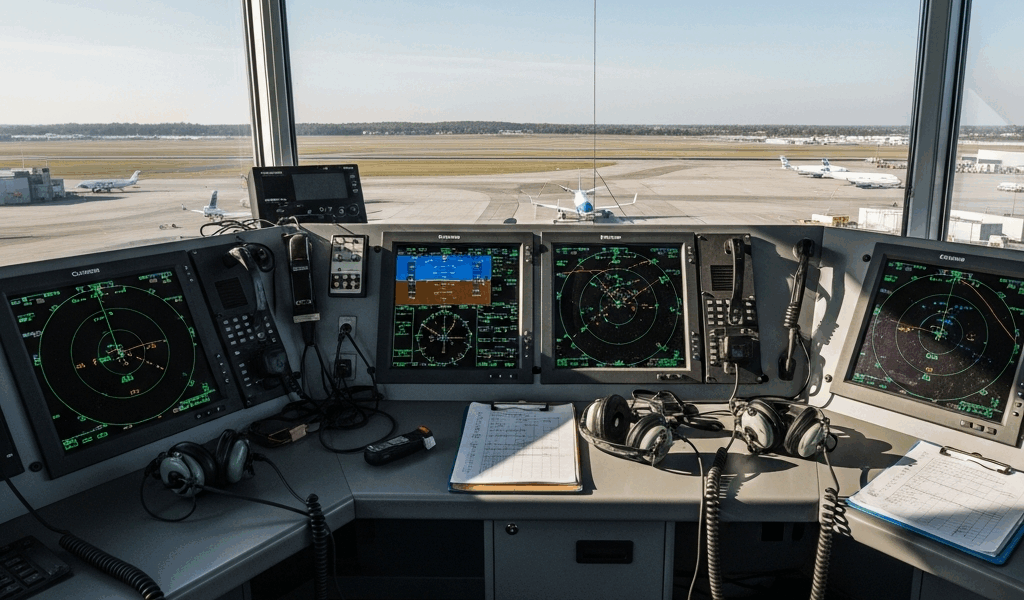
The Person Standing Between You and Chaos
Airshow culture has gotten complicated with all the spectacle and noise flying around. The pyrotechnics, the smoke trails, the deafening engine roar — it’s easy to miss the one person actually holding the whole thing together.
This article includes affiliate links. We may earn a commission at no extra cost to you.
But what is an air boss? In essence, it’s the single point of authority over every aircraft operating in the show box during those two or three hours you’re sitting in the stands. One person. Final say. Every time. But it’s much more than that.
Picture yourself on the flight line twenty minutes before the show starts. Fluorescent orange vest — sometimes yellow — standing at a position with clear sightlines to the entire performance box. Serious headset, the kind with a boom mic and multiple channels, not some casual earpiece. Their eyes never really leave the sky. Not watching the aerobatic routine happening right now, either. Looking ahead. Tracking where the next act is sitting. Monitoring wind. Watching the crowd line.
That initial sequence of radio calls — “Show One, say your altitude,” “Holding at pattern altitude southwest of the box,” “Cleared to enter” — almost musical in their rhythm when you actually listen. That’s the air boss orchestrating all of it. Every call carries weight. Every pause matters.
What the Air Boss Actually Controls During a Show
The job breaks into several concrete, non-negotiable responsibilities. Start with sequencing. The air boss determines the order acts perform — not the show director, not the announcers. Conditions change. Recovery time varies. Wind shifts. The air boss reads all of it in real-time and decides who goes up next.
That gap between a Pitts S-2B climbing out of the box and a T-6 Texan entering for its routine? The air boss manages that. Timing it live, using experience and radio communication to keep the flow tight without stacking aircraft or creating conflicting flight paths. Wings Over Dallas runs back-to-back acts almost seamlessly across five hours. That’s not luck.
They also enforce the box itself — an invisible rectangle of airspace defined by the FAA waiver granted for that specific show. Acts perform inside it. Period. A T-28 Trojan drifts fifty feet outside the lateral line? The air boss calls it. Performer corrects or comes out.
Probably should have opened with this section, honestly. Tower coordination is where most of the invisible complexity actually lives. The control tower manages general airspace around the venue. The air boss manages performance airspace. They need to talk constantly — position reports, wind updates, confirming clear airspace before the next act enters. Two separate authorities sharing one sky.
Then there’s crowd-line enforcement. Modern airshows maintain a spectator boundary somewhere between 500 and 1,000 feet from the performance box, depending on the waiver. The air boss monitors it visually and through spotters on the ground. Crowd edge creeping forward? Radio call to ground personnel. Maintaining that boundary is non-negotiable — every time, no exceptions.
The show director handles the program timing, coordinates with announcers, manages ground acts and cues. The air boss answers to them on logistics. But anything airborne? That’s absolute air boss authority.
How They Talk to Performers in the Air
Experienced air bosses operate on a dedicated radio frequency — separate from tower traffic, separate from everything else. Every performer monitors it. Every safety officer monitors it. Every ground crew member tied to the show monitors it. The phraseology comes straight out of military airshow protocols and carries zero ambiguity.
A pilot entering the box hears: “Show Two, cleared to enter the box, winds one-eight-zero at eight knots, altimeter three-zero-one-two.” Specific numbers. Clear instructions. No room for interpretation at 250 knots.
Once the routine is underway, the air boss monitors altitude parameters, lateral and longitudinal boundaries, waiver-specified minimums. Radio stays open. But here’s the part that genuinely fascinates me — experienced air bosses develop shorthand with acts they’ve worked with repeatedly. I’m apparently wired to notice this kind of thing, and once you see it, you can’t unsee it.
Russell Royce, who has air-bossed at major venues including the Reno Air Races, develops a real rhythm with specific performers he’s worked alongside for years. A pilot might key the mic three times instead of speaking a word. Understood. The air boss already knows that aircraft’s profile, that routine’s typical length, that pilot’s preferences. It becomes almost conversational after you’ve done it a hundred times together.
A performer executing a knife-edge pass cannot execute complex radio procedures mid-maneuver. The air boss accounts for this — calls timed for moments when the pilot can safely acknowledge. During high-G sequences? Radio stays quiet unless something critical demands otherwise.
When the Air Boss Shuts Down an Act or a Show
This is where the role becomes genuinely high-stakes. A hold call stops an aircraft from continuing its approach or maneuvers until conditions reset — weather moving in, another aircraft not yet clear, crowd-line emergency, mechanical issue spotted from the ground. The air boss sees it, calls it: “Show Four, hold altitude, hold position.”
The pilot does not debate this. They comply immediately. That’s not military arrogance — it’s protocol built on a simple reality. The air boss has the sightline advantage, the communication with all parties, the full operational picture. Their judgment is absolute in that moment.
An abort call is rarer and more serious. Significant waiver violation, signs of mechanical distress, conditions making continued flight dangerous. “Show Three, abort the routine, exit the box at your discretion.” That aircraft leaves. The routine ends. The show pauses until conditions reset.
Frustrated by a weather cell that rolled through Reno faster than the forecast suggested, the air boss that afternoon called a hold on the next act — eight minutes, cell moved through, then resumed. No drama. No debate about whether the conditions were “really that bad.” The call was made. Everyone trusted it. Don’t make my mistake of assuming airshow weather delays are just cautious bureaucracy. That eight minutes probably mattered.
How Someone Becomes an Air Boss
You don’t wake up and apply for “Air Boss” like it’s a standard job posting. Most come through decades of aerobatic flying, military background, or honestly both. The International Council of Air Shows — ICAS — certifies air bosses through a formal program requiring extensive experience documentation and direct evaluation.
Baseline requirements include military or civilian aerobatic experience, formal training in show operations, and demonstrated knowledge of federal waiver regulations. Russell Royce came up through military jet experience before transitioning into the airshow world and eventually air-bossing at major venues. That’s a common path — maybe the most common path.
You need to have flown these aircraft. Felt a stall. Managed wind shear. Made split-second decisions at altitude. Understood performance envelopes from inside the cockpit, not from a manual. ICAS isn’t certifying someone who studied hard. They’re certifying someone who has been at 4 Gs and made the right call anyway.
The number of certified air bosses across North America is small — a few hundred across all active shows, roughly. It’s not a crowded field. It’s specialized, experience-gated, and genuinely respected inside aviation in a way that’s hard to fully appreciate from the stands.
If you want to follow what the air boss is orchestrating from the spectator area, a solid pair of Nikon Monarch M5 8×42 binoculars lets you track aircraft positioning throughout the sequence — you start to see the timing and spacing that makes the whole show work.
For a current, source-based example of how air boss authorization and accident findings differ, read what official records show about Russell Royce.

Stay in the loop
Get the latest airshow spectacle updates delivered to your inbox.