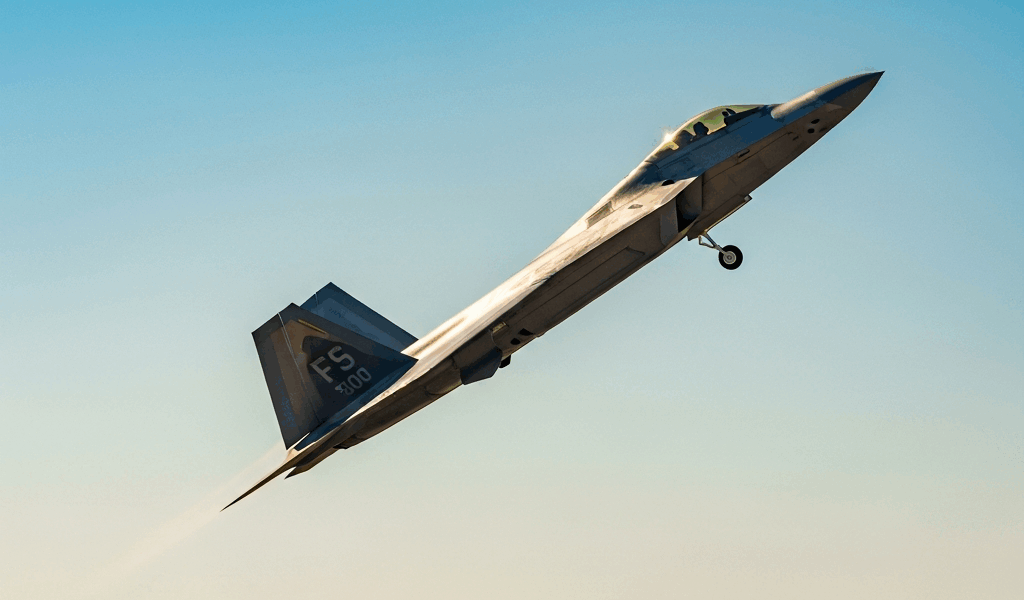
F-22 Raptor Airshows in 2025 Have Gotten Complicated With All the Conflicting Information Flying Around
Fair warning: the Raptor demo doesn’t play by normal rules. You’ll plan a trip, mark your calendar, tell your friends — and then a deployment quietly swallows the whole thing. I’ve been there. Eight hours of driving for nothing. So, without further ado, let’s dive in.
Why the F-22 Demo Is So Hard to Pin Down
But what is the F-22 Demonstration Team, exactly? In essence, it’s a single-pilot, single-jet operation carved out of active Air Force priorities. But it’s much more than that — it’s also the first thing to disappear when operational needs shift.
That’s what makes the F-22 demo so maddening to us airshow enthusiasts. The Thunderbirds commit a full six-ship team to a locked season. They rarely pull out. The F-22 demo? One pilot. One jet. If either gets tasked elsewhere, the demo evaporates entirely. Airshow organizers know this going in — which is exactly why you’ll see “pending” or “tentatively scheduled” on their websites for months. They’re not being evasive. They genuinely don’t have release confirmation until frustratingly close to show day.
Frustrated by a vague Facebook group post swearing the Raptor was on the manifest, I drove eight hours to a regional show in 2023 using printed MapQuest directions and a thermos of bad gas station coffee. It wasn’t there. A squadron rotation had pulled the demo pilot two weeks prior, and the airshow website hadn’t been touched since February. Don’t make my mistake.
Airshows With Confirmed or Likely F-22 Appearances in 2025
Probably should have opened with this section, honestly. These shows have either officially confirmed the F-22 demo or have hosted it reliably enough that 2025 looks like a reasonable bet. None are ironclad guarantees — but these are your best shots.
- Luke Days (Luke Air Force Base, Arizona — typically late March)
Luke is literally home to the F-22 Demonstration Team. The logistics are trivial — the jet and pilot are already there. This is the single most consistent show for catching a Raptor demo. Confirmation typically drops by February. - Defenders of Liberty Airshow (Barksdale Air Force Base, Louisiana — typically April)
Barksdale runs one of the Air Force’s largest public shows, and its proximity to Air Combat Command headquarters means the F-22 demo gets penciled in regularly. Check the official Barksdale AFB website around March for final word. - Naval Station Oceana Airshow (Virginia Beach, Virginia — typically May)
NAS Oceana has pulled the F-22 demo in several recent years through inter-command coordination. May timing helps — deployments haven’t fully kicked in yet, and the release window stays open longer. - Great Lakes Air Show (Waukegan, Illinois — typically July)
This civilian show has hosted the F-22 demo twice in the last four years. Civilian shows are harder to predict — Air Force release decisions come later — but Waukegan has earned a spot on the radar. I’m apparently a midwest airshow person, and this one works for me while bigger coastal shows never seem to deliver. - Vectren Airshow (Evansville, Indiana — typically June)
Regional shows occasionally land the F-22 demo when military partnerships and early scheduling line up right. Evansville’s connections to nearby Air Force facilities make it more feasible than most.
What the F-22 Demo Actually Looks Like Up Close
Nothing prepares you for it. Seriously.
It opens with a slow pass — dangerously slow. The F-22 comes down the flight line at roughly 300 knots, gear and flaps deployed, and the jet looks like it has no business staying airborne. Every single time, somebody nearby says “how is it not falling?” That’s the thrust-vectoring nozzles doing their thing. The sound hits you a beat later — not a high-pitched scream like an F-16, but a low, controlled rumble that feels more like weather than an engine.
Then the alpha demo starts. The nose pitches up — 60 degrees, 70, sometimes pushing 85 degrees angle of attack. The F-22 climbs vertical. Banks impossibly. Essentially hangs in the air with nozzles pointed down and sideways, generating thrust in multiple directions simultaneously. No fourth-generation fighter touches this envelope. Not even close.
Full afterburner follows on the vertical climb-out. The sound is genuinely startling if you’re unprepared — deep and sustained, felt in your sternum more than heard with your ears. The jet accelerates upward faster than your eyes want to track, rolls inverted at the top, comes back down knife-edge. Total demo time runs roughly 20 minutes. Sounds short. It isn’t — not when every second is dense.
Best Spots and Camera Tips for Watching the F-22 Demo
While you won’t need professional photography credentials, you will need a handful of practical tools and a decent position on the flight line. First, you should claim a ramp spot if the show allows it — at least if you want to actually feel the demo rather than just watch it. Don’t settle for bleachers 500 feet back. The control surface movements, the afterburner shimmer, the sheer scale of the thing — all of it disappears with distance.
A 70-200mm f/2.8 lens might be the best option, as the F-22 demo requires covering both close slow passes and distant vertical maneuvers. That is because the demo profile moves between roughly 200 feet off the deck and several thousand feet up within the same sequence — no fixed focal length handles that cleanly. Shoot continuous burst at 10-14 frames per second, shutter speed at 1/1000th minimum. Phone cameras will get you recognizable shots from the flight line. You’ll regret it anyway during the vertical climbs.
Ask a volunteer flight line manager which direction the wind is running that day — vertical climbs drift, and knowing the wind direction tells you which side of the crowd box the best angles will fall on. Small detail. Matters more than you’d think.
If a static display F-22 is available, walk it. Most people are surprised by how compact the airframe actually is standing next to it — leaner than an F-15 or F-16, with visible internal weapons bays and exposed engineering that photographs well at close range. The flight demo will land differently once you’ve stood next to the actual aircraft.
How to Check for Last-Minute F-22 Demo Changes
The F-22 Demo Team’s official X account and Facebook page are your most reliable sources — not fan pages, not group posts. Follow the specific airshow’s official accounts as well. That said, serious enthusiast communities on Facebook sometimes surface cancellations faster than official channels do. A dedicated spotter will notice a schedule change and post it within hours. Join those groups. People in them have logged dozens of shows and their intel holds up.
Set a calendar reminder for two weeks before the event. Check the official airshow website. If the F-22 demo still reads “pending” at that point, email the public affairs office directly. One email. They’ll give you a straight answer about whether the Raptor is actually coming. That’s a better system than driving eight hours on blind faith.
That was the 2023 lesson. Cost me a full weekend and about $340 in gas and a motel room off I-40. The email would have taken four minutes.

Stay in the loop
Get the latest airshow spectacle updates delivered to your inbox.