Finding a Harrier in 2025 Has Gotten Complicated With All the Misinformation Flying Around
The U.S. Marine Corps retired its last operational AV-8B Harrier squadron in 2019. That single fact explains everything. Airshows still featuring the jump jet in 2025? You can count them on one hand — maybe one hand with a couple fingers folded down.
Civilian operators are rarer still. The Flying Bulls, Austria’s legendary aerobatic display team, maintains one of the world’s few privately owned Harriers. A handful of warbird restoration outfits — Akse Aviation chief among them — have kept examples airworthy. Private collectors own a few more. But flyable airframes? We’re talking single digits. Globally.
Maintenance costs alone price out casual operators. A Harrier’s Rolls-Royce Pegasus vectored-thrust engine demands specialist technicians and parts sourcing that borders on archaeological work. One unplanned repair can ground the jet for months. I’ve talked to people who’ve watched their spring show appearances evaporate over a single failed component — sourced, eventually, from a retired Royal Air Force stockpile in the UK at what I’m told was an eye-watering price. That scarcity is why confirmed 2025 appearances matter, and why you shouldn’t assume any specific show will have one without calling the organizers yourself.
U.S. Airshows Confirmed or Likely to Feature a Harrier in 2025
I’ll be straight with you: confirmed bookings for 2025 are still trickling in. Most performer lineups don’t finalize until 60 to 90 days before the event. That said, certain shows have earned reputations with Harrier operators over the years. Those are the ones worth your attention.
EAA AirVenture Oshkosh — Oshkosh, Wisconsin (Late July)
Oshkosh is arguably North America’s biggest aviation gathering, full stop. Its military demo slot rotates annually, and warbird performers — vintage military jets included — show up reliably. The Flying Bulls have demonstrated there before. No official announcement had locked in a Harrier for July 2025 at the time I’m writing this, but the show’s scale and international participant roster make it worth checking their performer list as spring approaches. Set a calendar reminder for April. Seriously.
Daytona Beach Air & Space Show — Daytona Beach, Florida (March)
Daytona’s spring show has hosted military demo jets and vintage warbirds going back years. Experimental aircraft, retired military hardware — it’s that kind of lineup. Check their official site in January and February 2025 to see whether a Harrier operator has committed. Florida’s restoration and collector community makes it geographically plausible in a way that, say, a show in the northern midwest might not be.
Nellis Air Show — Las Vegas, Nevada (September)
Nellis hosts major military performers every year and attracts serious hardware. The active-duty Harrier is gone from U.S. service — that ship has sailed — but civilian warbird displays occasionally slot into the military demo flow. Worth tracking, though this one leans heavier toward current-generation fighters and legacy bombers. Don’t build your whole trip around a Harrier here. Monitor it, don’t bet on it.
The Problem With U.S. Shows Right Now
Honestly? Finding a confirmed U.S. civilian airshow Harrier appearance for 2025 was harder than I expected. The aircraft’s civilian demo footprint has shrunk dramatically since around 2015. Most domestic shows haven’t announced detailed performer rosters for mid-2025 events yet. That gap is exactly why the international scene matters — and why I’d seriously consider a flight to the UK before I’d gamble on a domestic show coming through.
International Harrier Demos Worth Knowing About
If you’re willing to travel, your odds improve significantly. Particularly in Europe and the UK. That’s where the birds are.
Royal International Air Tattoo (RIAT) — RAF Fairford, United Kingdom (July)
RIAT is the world’s largest military airshow by participant count. NATO air arms, international display teams, warbird operators — it consistently draws them all. The Royal Air Force occasionally flies Harrier heritage flights or displays during their participation. The Spanish Navy’s AV-8B Plus contingent sometimes appears as well. Announcements typically roll out in April and May. Transatlantic travel isn’t trivial — flights from the eastern U.S. to Heathrow run roughly $700–$1,100 in economy, and RAF Fairford is about an hour and a half west of London by car. But if a Harrier flies anywhere in 2025, RIAT’s three-day format makes it the best single bet on the calendar.
Farnborough International Airshow — Farnborough, United Kingdom (July, even-numbered years)
Farnborough alternates with RIAT on the UK airshow calendar. 2024 was RIAT’s year; Farnborough 2026 is next. That puts it outside our 2025 window entirely. Worth noting if you’re a planner who books eighteen months out — but for 2025 purposes, RIAT is your UK target.
Spanish Navy Participation at European Shows
Spain still operates the AV-8B Plus — a modernized Harrier variant — for active carrier operations. Their naval air arm maintains real inventory, not museum pieces. Spanish participation at European airshows, particularly in Southern Europe, sometimes includes Harrier demos. Shows in Portugal, southern France, and the broader Mediterranean region see these aircraft occasionally. Tracking Spanish Navy announcements through their defense ministry website or enthusiast forums gives you a geographic angle most U.S.-focused planners miss entirely. That’s what makes this option endearing to serious Harrier enthusiasts — it’s the one nobody outside Europe thinks to check.
The Flying Bulls’ European Tour Schedule
Based in Salzburg, Austria, the Flying Bulls maintain one of the world’s only privately owned display Harriers. Their annual tour typically runs May through September across European shows. Their website and social media announce scheduled appearances throughout the year. This outfit is your single most reliable source for confirmed Harrier airshow content in 2025. If anywhere in Europe fits your schedule, start here — check their site first, then plan everything else around it.
What Makes a Harrier Demo Different From Every Other Jet Act
Today I’ll share it all with you — because the difference is genuinely hard to explain until you’ve felt it.
Most jet demonstrations follow a predictable script. High-speed pass. Aileron roll. Vertical climb. Maybe a turnback maneuver. Harrier pilots find that routine mildly amusing.
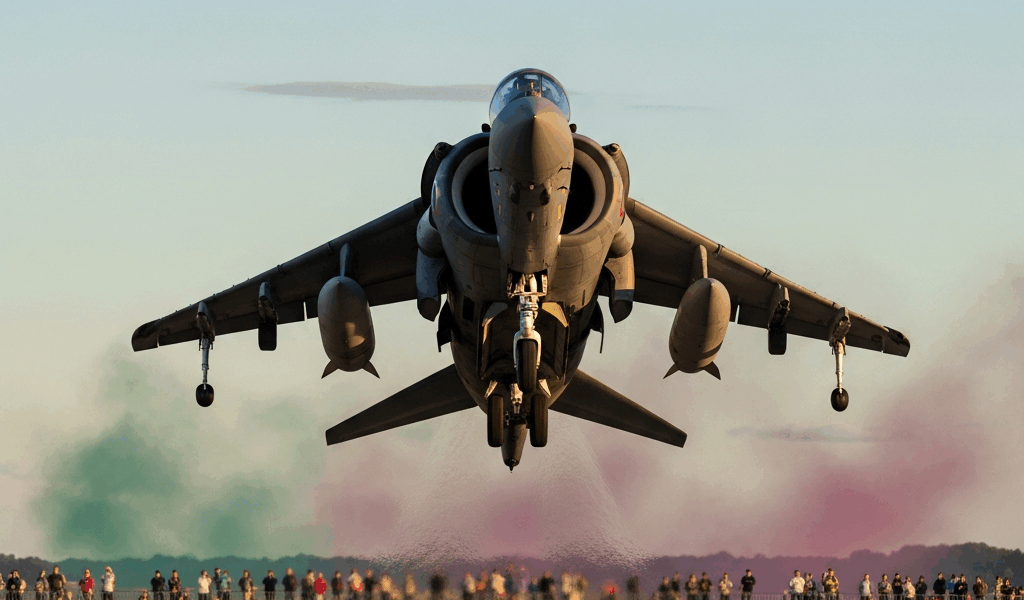
The moment a Harrier pilot transitions to hover, the physics flip. The jet doesn’t climb out of a dive or bank steeply — it slows from 300 knots to a dead stop mid-air, nose pitched up, hovering like a helicopter that forgot its entire identity. The Pegasus engine redirects thrust through four rotating nozzles. In a live demo, you hear the engine note change pitch as those nozzles rotate. Low. Distinctive. Not a sound any other jet produces.
Then the pilot translates sideways without turning the fuselage. Or climbs vertically while moving forward. Or executes what I can only describe as a controlled, slow-motion backflip. Every maneuver looks like it’s operating under a negotiated exemption from aerodynamic law.
From the grandstand, the sensory experience hits differently than you expect. The noise sits lower in frequency than an F-16 — almost subsonic in its rumble, something you feel in your chest more than you hear with your ears. The hover hold is dead still. No afterburner shimmer, no vertical drift. Just absolute poise at 50 feet, perfectly level, for as long as you want to stare at it. It’s not nostalgia. It’s witnessing something that genuinely shouldn’t work — and does, effortlessly, in front of your face.
How to Track Harrier Appearances Before You Book Anything
Probably should have opened with this section, honestly. Build a monitoring system now — before you’ve spent anything — and you’ll save yourself real frustration later. Don’t make my mistake. I booked a cross-country trip in 2018 based on a rumored appearance that never got officially confirmed. Ate the change fees. Lesson learned at roughly $340 in airline penalties.
While you won’t need to hire a research team, you will need a handful of reliable sources checked consistently:
- Official airshow websites. Search “[Airshow Name] 2025 performers” or “[Airshow Name] military demo” starting in February and March. Most U.S. shows finalize lineups by late spring — April to May is usually when rosters go live.
- The Flying Bulls’ official site and social media. Their schedule is your single most reliable data point for confirmed Harrier appearances anywhere in Europe. Check it monthly from January onward.
- Warbird Digest and AirshowStuff forums. These communities track performer announcements obsessively — I mean that as a compliment. Post a question there and you’ll get real-time updates from people actively watching the same shows you are.
- Spanish Navy official announcements. If you’re tracking AV-8B Plus appearances specifically, their defense ministry website and naval air arm social accounts post deployment and demo schedules. It’s in Spanish, obviously — Google Translate handles it fine.
- Akse Aviation’s website. They post scheduled appearances and ongoing restorations. Not every event hits the major announcement channels until surprisingly late. I’m apparently their kind of audience — obsessive planner types — and checking there first has served me well.
First, you should start checking in January for spring shows — at least if you want any hope of booking reasonable flights and lodging. By June, shift your attention to fall events. Seventy days out is when most rosters go public. Book travel only after you’ve seen the performer officially announced, not just the show date. One unconfirmed assumption is all it takes to turn an aviation pilgrimage into an expensive lesson in patience.



Stay in the loop
Get the latest airshow spectacle updates delivered to your inbox.