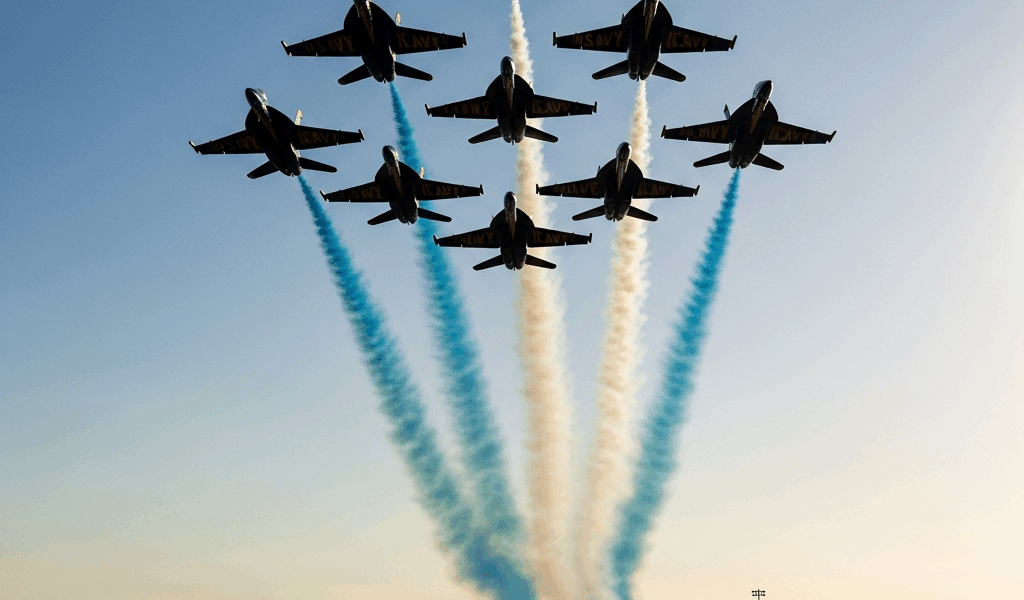
Tuesday, April 28. The U.S. Navy Blue Angels swapped their gold helmets for capes.
They spent the afternoon at Studer Family Children’s Hospital in Pensacola, Florida, alongside first responders, hospital staff, and volunteers for Superhero Day — an annual event organized by Ascension Sacred Heart that draws hundreds of pediatric patients, caregivers, and community partners. The premise is straightforward: reminding kids fighting serious illness that they aren’t doing it alone.
Personnel from the Escambia County Sheriff’s Office, Pensacola Police Department, and local fire departments were there too. Sailors and NAS Pensacola mascot J. Gosling made the rounds. For patients who could get outside, firefighters and deputies rappelled down the side of the building. For those confined to their rooms, the superheroes came to them — one bedside visit at a time.
On the ground, kids could build with Legos, decorate cookies, or stop by a custom hero-name station and walk away with their own superhero identity. U.S. Navy Chief Mass Communication Specialist Ian Cotter documented the day for official record.
Real Superheroes — Hospital’s Words, Not Ours
Jason Foland, President of Studer Family Children’s Hospital, kept his explanation simple:
“It’s to celebrate the staff and all the parents. Being in a hospital is a real challenge, so it’s acknowledging that they’re the real superheroes every day, to make sure the kids get the care that they deserve.”
NAS Pensacola Commanding Officer Capt. Chandra Newman spoke to something larger — the base’s relationship with the city around it, one that stretches back two centuries:
“It’s our kids too. We have folks that work and live on the base that use the facilities on the installation as well. But this is a Navy town, this is a Navy base, we’ve been here for 200 years with the community and just keeping those bonds tight.”
More Than a Photo Op — A Recurring Commitment
This wasn’t a one-time visit. Blue Angels Captain and Flight Surgeon Jen Murr and Hospital Corpsman Second Class Justin Spence had already been to Studer Family Children’s Hospital in December 2025, bringing books, stickers, and team merchandise ahead of the holidays. That kind of outreach isn’t incidental — the Blue Angels’ official mission statement specifically calls out community visits to schools, hospitals, and civic functions at each show city, with the team reaching more than 50,000 people annually through those appearances.
April 28 also happened to be a scheduled Blue Angels practice day — the same afternoon the team showed up for the kids.
Context — On-Base Access Curtailed This Spring
The visit comes during an unusually restricted stretch at NAS Pensacola. Following a security incident in early March and elevated military threat levels tied to ongoing U.S. operations, the base shifted to DoD ID card-only access on weekdays. Weekend civilian access is now limited to Saturdays and Sundays, 9 a.m. to 3 p.m. Blue Angels flight-line practice viewing behind the National Naval Aviation Museum — one of the most popular free aviation attractions on the Gulf Coast — remains suspended until further notice.
For the families at Studer, none of that mattered Tuesday. The Blue Angels came to them.
What’s Next in Pensacola
The team’s next major Pensacola-area public appearance will be the Red, White & Blues Pensacola Beach Air Show, July 15–18, 2026. The Blue Angels’ F/A-18E and F/A-18F Super Hornets and C-130J Fat Albert will close the show daily over the Gulf at 2 p.m. Also confirmed: aerobatic pilot RJ Gritter, the father-son Redline Airshows team of Ken and Austin Rieder flying their RV-8s, and the four-ship Titan Aerobatic Team in WWII-era AT-6 Texans.
Later in 2026, the NAS Pensacola Blue Angels Homecoming Air Show is set for November 6–7, with 150,000 to 180,000 attendees expected — routinely one of the largest air shows on the eastern seaboard.
Studer Family Children’s Hospital has served the Gulf Coast for more than 50 years. Its 126-bed facility includes pediatric oncology, surgery, intensive care, and the region’s only Level III neonatal intensive care unit — the kind of place where a cape and a handshake from a Blue Angel can mean everything.


Stay in the loop
Get the latest airshow spectacle updates delivered to your inbox.