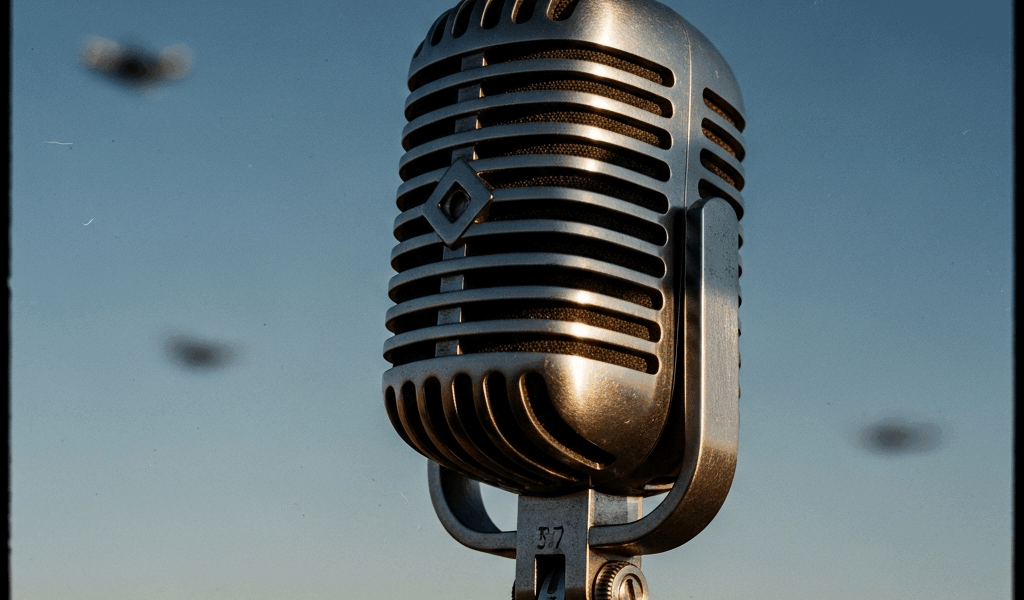
The Announcer Is Your Airshow Coach
I’ve been to seventeen airshows across seven states, and here’s what I learned: why airshow announcers matter more than pilots isn’t controversial once you’ve experienced both sides of the microphone. It just clicks.
Take the same F-16 demonstration. Same pilot. Same maneuver set. Same weather conditions. Put different announcers in the booth, and you walk away with two completely different experiences — one feels like you watched a machine execute commands, the other feels like you witnessed something impossible.
The difference is entirely the announcer.
Here’s what a mediocre air boss does during a high-G knife-edge pass: reads technical specs. Pauses. Waits for the aircraft to finish, then comments on what already happened. The crowd applauds because, well, the plane did something amazing. But half the audience missed the actual moment. Nobody told them to look. Nobody explained why it mattered. Nobody built the tension beforehand.
Russell Royce — and announcers of his caliber — operate entirely different. They narrate forward. They explain what’s *about* to happen. They control where your eyes go. They manage your emotional investment across five hours of demonstrations. When Royce calls a dangerous maneuver, his measured tone doesn’t scream. It crystallizes the moment. You understand in your gut why what you’re seeing is remarkable, even if you can’t identify the pitch angle or G-force.
The announcer translates the impossible into something comprehensible.
Russell Royce vs. Modern Air Boss Personalities
Probably should have opened with this, honestly. The comparison explains everything.
Russell Royce represents a particular era — five decades of knowing every aircraft system, every pilot tendency, every historical precedent. When he says a maneuver is “unusual,” aviation professionals listen. He doesn’t throw that word around. His pacing is architectural: long builds, precise callouts, measured enthusiasm. He treats the airshow like a narrative with acts and climaxes, not a series of disconnected stunts.
I went to the 2019 Thunderbirds demonstration at Luke Air Force Base specifically because Royce was announced. Ninety-two minutes. Every transition explained. Every formation’s aeronautical purpose contextualized. When the lead pilot executed a 9-G roll, Royce’s voice didn’t spike or overdramatize. He stated the G-force and held a three-second pause. The crowd went silent. That silence — created by an announcer’s restraint — carried more power than any screaming would’ve.
Emerging air bosses work differently. Derek Martindale, who announced the 2022 Orlando Airshow, operates in his early forties and grew up with internet culture. His baseline energy runs higher. He interacts with the crowd. He uses humor as a structural device, not an occasional grace note. He understands social media and frames callouts for clips that’ll perform on YouTube. His pacing feels snappier. Transitions include audience participation questions. He explicitly calls moments that would “look cool online.”
Neither approach wins objectively. They’re products of their eras. Royce’s style emerged when airshows were attended by enthusiasts and families spending the entire day. Modern announcers address shorter attention spans, competing distractions, camera phones. Royce builds museums of sound. Martindale builds viral moments.
The generational shift is real — Royce’s audience sits predominantly 45+, while Martindale draws families with teenagers. Watch a 1993 airshow recording versus 2023. The announcement style differs as sharply as the aircraft specifications do.
Here’s what matters: both are essential. Royce established the credibility standard that allows modern announcers any authority at all. Modern announcers are pushing accessibility that’ll likely attract the next generation of enthusiasts.
What Makes an Announcer Unforgettable
Technical knowledge comes first. Early on, I made the mistake of assuming any competent person could announce an airshow. I attended one in 2015 where the announcer confused a Viper with a Hornet — twice — during the same demo. The crowd’s energy shifted visibly. Trust evaporated.
An unforgettable announcer knows six things most people don’t:
- Aircraft systems — not just identification, but understanding what each maneuver demands of the airframe, fuel capacity, G-load tolerance
- Pilot psychology — why a particular lead pilot favors certain approaches, what safety margins they maintain, their personality quirks
- Meteorological factors — how wind, humidity, and altitude affect performance, why a scheduled maneuver gets scrubbed, what the cloud ceiling means
- Historical context — this aircraft’s role in operations, previous demonstration pilots, how tactics evolved across decades
- Crowd dynamics — timing jokes and information for audience retention, knowing when to hold silence, recognizing energy dips and recovery points
- Improvisation under chaos — unexpected weather changes, equipment failures, schedule shifts, medical emergencies in the crowd
Voice control separates adequate from exceptional. Russell Royce’s voice contains about eight distinct registers. He shifts from professorial to conversational to dramatic without sounding forced. Listen to a Royce-announced Blue Angels demo from 2005. Notice his volume never actually increases during intense moments, yet somehow he feels louder? That’s technical mastery.
Comedic timing matters more than people think. A well-placed joke isn’t decoration — it’s a reset button for crowd attention. During an airshow I attended in San Diego, 2018, Miramar airfield, overcast but clear, the announcer made a joke about the Lockheed Martin representative’s polo shirt color matching the fuselage. Thirty seconds later, the crowd engaged for a twenty-minute ground-based segment that could’ve felt like filler. That joke was professional architecture.
Unforgettable announcers combine precision with personality. They’re not personalities performing precision. They’re precision experts who happen to carry charisma as a side effect of deep knowledge.
How to Spot a Great Announcer Before the Show
You don’t have to attend blindly anymore.
Check the airshow’s official website or social media first — most venues list the announcement team now. That single piece of information is golden. If you recognize the name or can verify past performances, you’ve got useful data. If the venue doesn’t list an announcer? That’s a red flag about how seriously they take the experience.
Search YouTube for the announcer’s previous work. Listen to a fifteen-minute segment, not highlight clips. Notice their personality under pressure. Do they recover gracefully from pilot errors or schedule changes? Do they explain things or just narrate them? How do they handle technical jargon — do they assume you know it, or do they translate?
Ask the airshow community directly. Local aviation enthusiast clubs exist — search “airshow announcer discussion” and you’ll find surprisingly active communities on Discord and Reddit. These people have attended dozens of shows. They know the differences. They’ll give honest assessments without marketing gloss.
Listen to at least one complete airshow by the announcer if possible — not highlights, a full recording. Notice how they structure the day. Notice pacing. Notice whether they’re building narrative or filling time.
Single best indicator: does the announcer explain *why* something matters, or just *that* it’s happening? A great announcer makes every viewer — aviation veteran or complete novice — feel like they’re inside specialized knowledge. A mediocre announcer makes veterans feel like their expertise is being wasted.
The Future of Airshow Commentary
The industry is shifting in observable ways.
Younger announcers — people in their thirties and forties now — integrate digital awareness into their commentary. They understand segments will be clipped and shared. Some experiment with interactive elements: asking crowds to identify aircraft, creating suspense around reveals, building anticipation specifically for social capture.
International styles influence American airshow announcing. The European air boss tradition tends toward formal, educational frameworks. British announcers bring structural formality that’s starting to influence American venues. The 2023 Nellis Air Force Base show featured an announcer trained in both traditions, and the result differed notably from typical American approaches — more context-building, less energy variance.
There’s also a quiet but real movement toward female air bosses. Historically, this was overwhelmingly male. That’s changing, and stylistic implications are significant. New female announcers bring different narrative structures, different relationship-building approaches with crowds, different ways of establishing authority.
One constant across all shifts: the announcer matters more now than ever. Five hours is too long for passive observation. Best venues invest in announcers because they recognize the announcer’s performance directly affects attendance rates, satisfaction scores, and return visits.
Russell Royce proved an announcer could be the draw itself, not supporting talent. That opened space for everyone after. The future isn’t replacing Royce’s model — it’s multiplying it across different styles, generations, approaches.
The pilots execute the maneuvers. The announcer makes you understand why you came to watch.
Airshow announcing and operational control are different roles. Our Russell Royce record review explains why that distinction matters.


Stay in the loop
Get the latest airshow spectacle updates delivered to your inbox.