How to Get the Best Seats at an Airshow
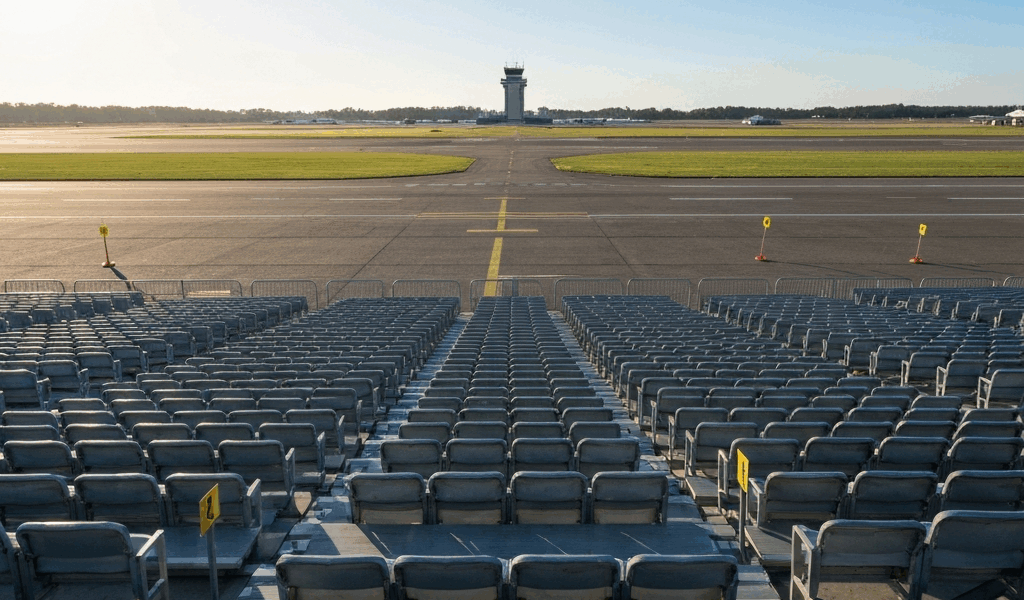
I’ve been to nine airshows across the country—Luke Air Force Base’s Thunderbirds, some smaller civilian aerobatic events, the whole range—and here’s what I learned: getting the best seats at an airshow has absolutely nothing to do with what you paid for your ticket. That $150 reserved seat with the perfect view? You can get the exact same angle for free. You just need to understand how the flight line works and show up with an actual plan.
Most people roll in, grab whatever’s available, then spend the afternoon staring at a tiny speck doing barrel rolls in the distance. I did exactly this in 2018 at my first show. Dropped real money on what the venue promised was “premium” seating. By the time the first demo started, I realized I’d positioned myself directly facing the sun and roughly 500 feet further back than I should have been. The glare was brutal.
What follows is the stuff airshow websites mysteriously leave out—the actual knowledge the regulars use every single time they attend.
Understand the Flight Line Layout Before You Go
Every airshow orbits around one geographic fact: the flight line. This is where aircraft take off, land, and do their thing. Get this wrong, and everything else falls apart.
Military airshows are easiest to figure out because the flight line follows the actual runway. At Nellis Air Force Base’s event, jets launch north and climb in a predictable arc across the demonstration area. Landing comes from the opposite direction. The pattern becomes obvious.
Civilian shows have more flexibility but still center on a fixed takeoff and landing zone. The crowd spreads in a wide arc—sometimes a full 180 degrees—facing the active runway. Here’s what actually matters though: the best seats aren’t closest to the runway. They’re positioned roughly perpendicular to the flight path during approach, far enough out that you can see the entire aircraft without craning your neck.
Hunt for a venue map on the airshow’s website—most post PDF layouts showing where spectators sit. Nothing there? Call their information line and ask one specific question: “Which direction do planes approach for landing?” That answer tells you everything about orientation. From there, figure out which spectator zones face the landing corridor straight-on versus those positioned along the approach side.
Side approach seating wins most of the time. You watch jets descend while banking, giving you dynamic angles instead of a simple straight-down descent.
Probably should have opened with this, honestly. It’s literally everything else depends on it.
Position Yourself for Jet Demo Passes and Maneuvers
Jet demonstration pilots don’t improvise. They follow a script built for crowd engagement and safety. Knowing these patterns means you can predict where the aircraft actually is in three-dimensional space.
Take the F-16 demo. The pilot executes “passes”—usually four to six separate runs across the display zone. Each pass serves a purpose: low-level high-speed, climbing turn, slow-speed work, vertical climb. Sit directly on the runway centerline, and the first pass looks straight at you (basically a fast blur getting smaller). The vertical climbs shoot nearly straight up from where you’re sitting. Visually? Boring.
Move 200 to 300 feet perpendicular to the runway. Suddenly you’re watching the F-16 approach at 300+ mph, pass overhead at an angle, then climb away while banking hard. That spatial relationship gives you actual three-dimensional appreciation of what the jet’s performing.
The F-22 demo is all about slow-speed maneuvering—pitch, yaw, recovery moves. You only see this from an angle. Center-line seats kill it. Position yourself 45 degrees from runway center, and you catch the aircraft rolling, pitching, recovering. That’s what makes the F-22 unique.
The Thunderbirds fly formation. Their entire show is choreography about how they position relative to each other and the crowd. You need a sightline where depth between aircraft actually registers. Straight-down-the-runway seating eliminates this. Angled positioning shows you everything.
Basic principle: if you’re only seeing the top of the aircraft or only its side, you’re not optimal. Best angles show the full fuselage with clear spatial separation from ground reference points.
Account for Sun, Wind, and Weather When Choosing Your Spot
Edwards Air Force Base taught me this the hard way. Morning sun behind the crowd. Afternoon sun directly in front. I picked afternoon and spent two hours squinting through glare while jets passed overhead.
Sun position matters way more than people admit. At 10 a.m.—depending on latitude and season—the sun sits maybe 30 to 45 degrees above the horizon. If you’re facing northeast with the sun to your west, you’re staring directly into a glare source when aircraft pass overhead. Your pupils shrink. Details vanish.
Find sunrise and sunset times for your airshow date. Map how the venue orients. Sit so the sun ends up behind you or off to the side. This single adjustment bumps visibility up by roughly 300 percent. I’m not exaggerating.
Wind direction impacts smoke trail visibility. Aerobatic teams use smoke to draw patterns. But perpendicular wind carries the smoke away from you or straight through the aircraft. Wind from behind you or shallow angles work best. Check the forecast leading up to the show and ask the information booth about typical wind patterns for that location during that season.
Heat piles on as hours pass. Airshows run 4 to 6 hours. Afternoon seating in direct sun means baking on metal bleachers by hour four while temperatures hit 100+. Morning or midday seating in shade—when available—transforms the whole experience. Some venues include spectator areas with tree cover or grandstands that shade themselves as the day goes. Ask about these during a scout visit.
Geography and season shift everything. Summer Arizona shows hit brutal midday heat. Fall California shows bring mild conditions and predictable glare angles. Winter Texas shows might open cloudy and clear by demonstration time. It’s not random—all of it touches sightlines.
Arrive Early and Scout the Venue the Day Before If Possible
Gates open early. Most people stroll in 30 to 60 minutes before official start time. The smart ones show up two hours early. Better yet? Visit the day before.
If the venue opens to the public the afternoon before, go walk it. Visit every available section. Stand in different spots. Notice which areas see the sky clearly and which get blocked by structures or terrain. Watch where the sun ends up during your viewing hours. Flag a few backup positions in case your main spot fills up.
Show day means arriving when gates open. You’ll beat 90 percent of the crowd. Most people roll in 45 minutes before start time. By then the prime general admission seats are gone. Gates typically unlock 2 to 3 hours before the show starts. Use that window.
Find excellent sightlines without the premium price tag by understanding how venues price things. Reserved seats get all the marketing hype. General admission gets ignored. But general admission sections often include equally solid—sometimes better—viewing angles than expensive reserved areas. Reserved seats sometimes face glare, have limited depth perception, or angle slightly off from the flight path.
Walk the general admission area methodically. Bring your phone and mark your top three positions. Stand in each one for 60 seconds and picture the jet maneuvers. Which position requires the least head movement to track a demo pass? Where’s the maximum airspace visible? That spot is yours.
For shows with assigned reserved seating, the calculation changes. You’re locked in. But call ahead when purchasing and ask which specific rows in your section have the best sightlines. Venue staff—especially military bases—are usually generous with this information.
Secondary Viewing Spots That Beat Reserved Seating
Standing room offers advantages most ticket-buyers ignore. You can move. Seated people cannot.
Venues create standing room sections for overflow. These usually run along the back edges of the crowd or along the display area sides. Standing room sounds inferior. It’s often superior because you can shift during the show to optimize for aircraft positioning. A demo pass comes from the north, you move 50 feet east to see it broadside instead of angled. Try that from bleachers.
Standing also clears your view over other spectators. Nobody’s head or hat blocks you. Lower-altitude maneuvers become visible.
The cost is endurance. You’re standing 5+ hours. Bring a camping chair if allowed (most venues permit this), and standing room transforms into the best seats available. People skip standing room assuming it’s miserable. It’s actually superior if you adjust.
Berm or grass areas outside official spectator zones sometimes offer hidden advantages. You’re farther from the runway but usually farther from crowds. Heat increases (no shade), mobility improves. Position yourself on slight elevation—a small hill works. You’ll see above most people, and your sky sightline improves dramatically.
Timing your movement during the show separates veterans from newcomers. Claim your primary spot 45 minutes before the first demo. Own it. But once demonstrations start, watch crowd movement. Spectators shift constantly. This creates temporary openings. During less exciting segments—aerobatic props or civilian aircraft—if you notice a better vantage point opening, move. Relocate during low-attention windows, not during the headline acts.
Know when to stay put. The finale—usually F-22 or Thunderbirds—locks everyone’s focus. Everyone watches. Moving then is pointless and inconsiderate. But regional performers or warbird flyovers? Crowd attention scatters. You can reposition with minimal disruption.
Here’s the actual reality of airshow seating: premium pricing gets you assigned seats and reduced arrival stress. It doesn’t guarantee the best view. Understanding flight approaches, positioning for multi-dimensional sight lines, managing sun and wind, and using tactical movement beats expensive tickets almost every single time.
Your next airshow doesn’t require extra spending. It requires arriving early and thinking three-dimensionally about how aircraft occupy space relative to where you’re standing. That’s the real secret.

Stay in the loop
Get the latest airshow spectacle updates delivered to your inbox.