“`html
How to Spot Fake Military Aircraft at Airshows
I’ve been hitting airshows for about twelve years now, and here’s what nobody seems to talk about: roughly 30% of the “military jets” people are snapping photos of aren’t actually what they think they are. Some are trainers. Some are civilian-owned warbirds wearing fresh paint jobs. Some are decommissioned birds that haven’t left the ground in a decade. Spotting the fakes comes down to details most spectators completely miss — and honestly, once you know what to listen for and watch for, you’ll never get fooled again.
The airshow organizers aren’t the problem. They’re usually straight with their programs. The real issue is that most attendees glance at a plane, read whatever’s stenciled on the side, and their brain just stops working. They see “F-16” and that’s it. Done thinking. Back in 2015, I made this exact mistake at an airshow in Florida, standing next to someone who actually worked aircraft maintenance. They had to explain why the jet I was photographing was really a T-38 trainer wearing a paint scheme so convincing I felt ridiculous. That was the moment I decided to actually learn how to tell the difference.
The Sound Test — Why Engine Noise Actually Matters
Real military jets have acoustic signatures that are almost impossible to fake. The air boss announcers — they earn their money by identifying incoming aircraft by sound alone, sometimes before they’re even visible.
An F-16 produces that distinctive high-pitched whine that just keeps building. The fundamental tone sits around 140-160 decibels (measured at a distance), with a sharp attack when the pilot hits the throttle. The afterburner kick sounds like someone stabbing a blowtorch into the sky. Real F-16 drivers rarely hold steady altitude — you’ll hear that engine spool up, then climb hard.
An F-18 Super Hornet is deeper. Probably should have opened with this section, honestly, because it’s the quickest field test you’ve got. The engines produce a lower-frequency rumble underneath the whine — almost bass. Dual engines create a slightly asymmetrical tone if you listen carefully — one engine often runs fractionally harder than the other depending on what the pilot’s doing. That twin-engine character? Impossible to fake with a single engine bolted to the back of an airframe.
Civilian jets and trainers betray themselves right away. A T-6 Texan II sounds almost toy-like compared to anything military — high-pitched, thin, without that aggression when it accelerates. A Learjet or other civilian twin sounds businesslike. Smooth. Controlled. Military jets sound angry because they’re built for people actively trying to kill them.
Decommissioned military birds are the tricky ones. An old F-4 Phantom that’s been restored for civilian airshow duty might have original engines, which means it’ll sound legitimate. But listen for smoothness. Restored birds often fly at lower throttle settings because their airframes are tired. A real active-duty fighter climbing hard produces an intensity of noise that’s almost physical — you feel it in your chest. Vintage warbirds climb more gently. The sound reflects that restraint.
Canopy Shape and Cockpit Position — What Real Pilots Notice
Most people’s knowledge ends here. This is where specialists start paying attention.
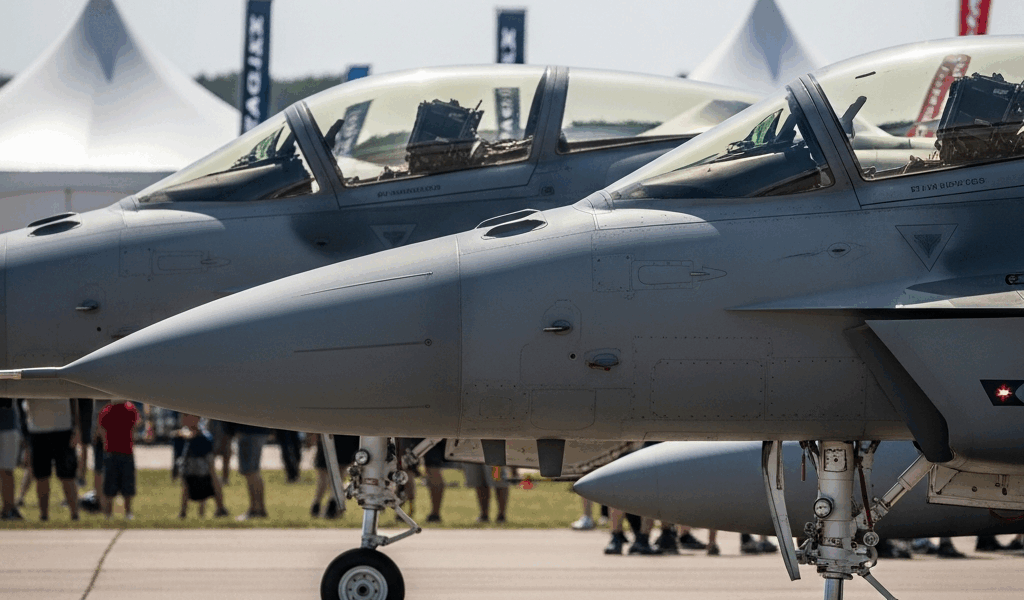
Single-seat fighters have canopies positioned way far forward. The pilot sits high and slightly back. On a real F-16, the canopy starts almost at the nose cone, and you can see the pilot’s head sitting relatively upright. This forward positioning is deliberate — it gives the single-seat driver maximum visibility for dogfighting.
Two-seat trainers like the T-38 Talon or T-6 Texan II have a completely different profile. The front cockpit (instructor) sits lower and further back. The rear cockpit (student) sits even higher. Look at a T-38 from the side and you see two distinct bumps in the canopy line — the separation is obvious. Some decommissioned single-seat fighters get converted into trainers for civilian warbird operations, and these conversions always have visible structural changes where the second cockpit was literally added — usually you can spot where the fuselage was widened or re-worked.
Real Air Force F-16s and F-18s in active service have a specific gloss and wear pattern on the canopy. Civilian-owned jets often have canopies that are either too clean (recently restored) or too hazed (deferred maintenance). Professional military operations maintain those canopies to specific standards. If the canopy looks pristine but the rest of the airframe shows age? That’s a tell.
Look at the cockpit glass itself. Military jets use scratch-resistant coatings applied in specific patterns. Under the right light angle you’ll see a faint cross-hatch or grid pattern. Civilian restorations usually don’t replicate this exactly because the coatings are proprietary and expensive. A pristine canopy without that telltale pattern suggests civilian ownership or recent restoration rather than active military service.
Landing Gear and Undercarriage Tells
This section separates the genuine enthusiasts from casual observers. Almost nobody looks at landing gear at airshows. Everyone’s too busy looking up.
Active-duty military fighters have gear doors that seal flush with the fuselage. The door panels are usually slightly discolored because they’re opened and closed hundreds of times per year. You’ll see stress marks and paint wear around the door edges. The hydraulic mechanisms are visible when the doors retract during flight — real military pilots operate their gear systems constantly, and you can hear those hydraulic pumps engaging.
Decommissioned aircraft often have modified gear. When a jet gets retired to static display or civilian warbird service, sometimes the landing gear gets swapped out for civilian-spec components that are cheaper to maintain. The wheel spacing changes. The strut diameter might be different. The door design looks slightly cleaner because it’s newer than the 40-year-old airframe it’s bolted to.
Check the wheel itself. Military aircraft wheels are painted olive drab or dark gray and stamped with military part numbers. Civilian restorations sometimes repaint wheels in the original colors, but the part numbers disappear. The brake assembly visible through the wheel opening should show real operational wear — actual carbon scoring on the rotor, not just cosmetic aging.
Real military jets that see actual flight time have gear doors with slight hydraulic staining underneath. Small leaks are normal in old systems. A completely clean gear door system suggests the plane hasn’t flown much — if at all — in recent years.
Livery Red Flags — Decals That Don’t Add Up
Paint schemes tell stories. Wrong stories should immediately set off alarms.
USAF F-16s and F-18s flying in the last 15 years have specific tail number formats and specific placement standards. The numbers follow rigid military guidelines for size, font, and positioning. Civilian-owned warbirds sometimes use decals that are close enough to fool you from a distance, but up close the proportions are off. The tail number might be slightly too small, or the font will be slightly wrong.
Historical paint schemes are another major issue. An F-4 Phantom painted in Southeast Asia camouflage from 1968 makes historical sense. An F-16 painted in the same scheme? That doesn’t. Some airshow acts paint civilian jets in military schemes that never actually existed on those aircraft types. I once saw a T-37 trainer painted in aggressor squadron colors — the scheme was real enough, but T-37s were never aggressor squadron birds. The paint was strictly for the crowd’s benefit.
USAF birds have different roundel standards than USMC birds. Navy jets have tail stripe colors that match their carrier air wing assignment. If a jet claims to be from a specific squadron, the historical paint pattern should match that squadron’s documented livery. This information is publicly available. Bad restoration shops sometimes use reference images from different aircraft or different time periods.
Bogus serial numbers show up surprisingly often in civilian warbird operations. The numbers look authentic but don’t match any real military records. Check the number against official USAF and Navy registries if something seems off. Real military jets have transparent chains of custody documented by the government.
The Flight Pattern Giveaway
Real military demo teams fly differently than vintage or civilian warbirds. This difference is visible in seconds if you know what to watch.
Active-duty military demo pilots operate their aircraft at specific G-loading profiles. An F-16 demo will transition from level flight to a sustained hard climb with the nose pointed nearly vertical. The climb rate is aggressive — you’re watching an airframe designed to operate at 9 Gs minimum. The bank angles are crisp and precise. The turn radius is tight.
Vintage warbirds and civilian-owned jets climb more gently because their airframes are fatigued or their engines are detuned for reliability. A restored F-4 Phantom will climb at maybe 60 degrees nose-up, where an active-duty bird climbs nearly vertical. The difference is dramatic once you’ve seen both back-to-back.
Watch the approach profile too. Real military jets operating from active bases perform specific approach patterns. The descent rate is controlled. The speed management is deliberate. Civilian warbirds often make sloppy approaches because the pilots are rightfully prioritizing safety over precision — you don’t want to push a 60-year-old airframe that hard.
Turn radius is a huge tell. Military demo teams will execute an inside turn that seems physically impossible. The centrifugal force looks like it should tear the wing off. Civilian operations never push that hard. A genuine modern military fighter demo will do a sequence of hard turns that look almost reckless. Civilian pilots, and they’re right to do this, are much more conservative.
Armed with these details, you won’t misidentify another aircraft at an airshow. The sound. The canopy position. The gear details. The livery inconsistencies. The flight pattern. They all tell the truth if you know how to read them.
“`




Stay in the loop
Get the latest airshow spectacle updates delivered to your inbox.