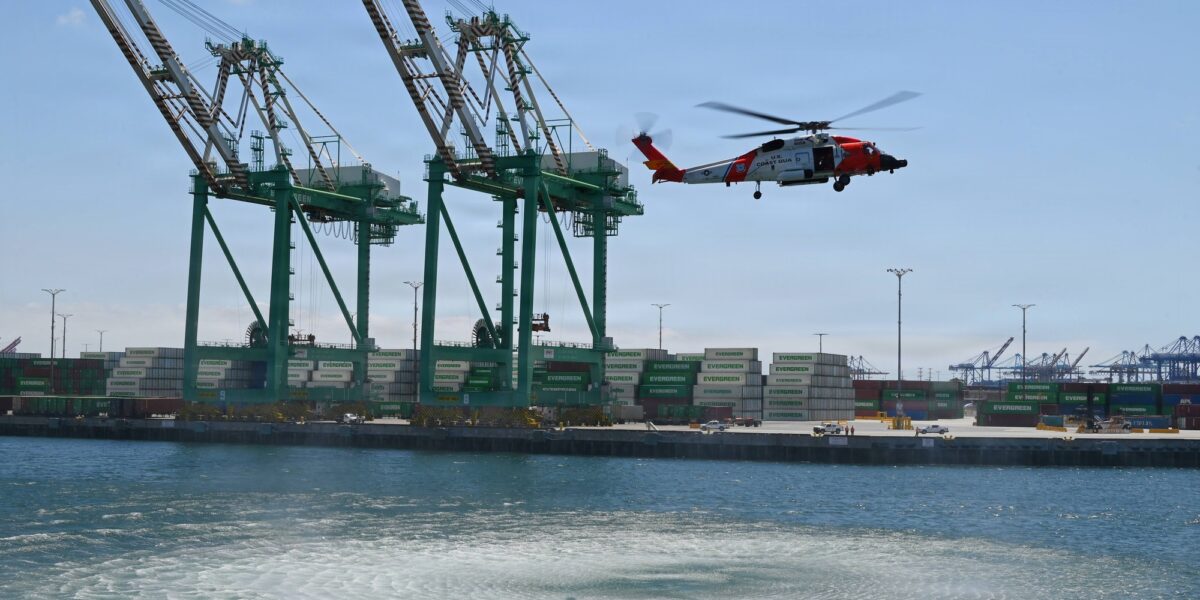
Helicopter flight displays trade a jet’s speed for something just as demanding: precise hovering, sideways and rearward flight, steep tactical turns, rescue-hoist work and, in a very small class of specially prepared aircraft, aerobatics. The important distinction is that there is no single national “helicopter demonstration team” in the United States. Most appearances are role demonstrations supplied by operational military or rescue units, so the aircraft and routine vary from one airshow to another.
Types of helicopter flight displays
| Display type | What spectators may see | Typical aircraft |
|---|---|---|
| Aerobatic helicopter | Loops, rolls, vertical maneuvers, nose-down recoveries and smoke | Specially prepared MBB Bo 105 |
| Military role demonstration | Quick stops, steep turns, tactical approaches, troop or cargo profiles | CH-47 Chinook, UH-60 Black Hawk, AH-64 Apache |
| Search-and-rescue demonstration | Precision hover, rescue swimmer deployment, basket or hoist recovery | MH-60 Jayhawk, MH-65 Dolphin and local rescue helicopters |
| Formation or flyby | Multiple helicopters in trail, echelon or tactical formation | Military, police or civilian teams |
| Static and ground demonstration | Cockpit access, equipment explanations and crew presentations | Operational helicopters of many types |
Can a helicopter really fly upside down?
Yes—but only certain helicopters, flown by specifically qualified pilots, can safely perform aerobatic maneuvers. Red Bull documents pilot Aaron Fitzgerald flying the MBB Bo 105 through flips, barrel rolls, nose dives and inverted portions of a routine. Its rigid rotor system and specially prepared aircraft make those maneuvers possible. That does not mean a normal helicopter can attempt them, nor that the Bo 105 hovers indefinitely upside down.
The FAA defines aerobatic flight as an abrupt attitude change, an abnormal attitude such as inverted flight, or abnormal acceleration. Its airshow provisions require helicopter aerobatic pilots to remain within their authorized maneuvers and establish specific separation from spectators. In practical terms, the inverted moment is part of a dynamic loop or roll: rotor thrust, aircraft energy and control inputs keep changing throughout the maneuver.
Official background: Red Bull’s Aaron Fitzgerald profile and the FAA helicopter airshow provisions.
Military helicopter role demonstrations
CH-47 Chinook
A Chinook role display emphasizes the capability of a large tandem-rotor transport rather than conventional airplane-style aerobatics. Spectators may see steep approaches, rapid deceleration, tight low-speed turns and precision hovering. The U.S. Army describes the CH-47F as its heavy-lift cargo helicopter, with a maximum gross weight of 50,000 pounds and a maximum cruise speed of 160 knots. Those numbers explain why a vigorous Chinook display looks so improbable.
The Royal Air Force maintains a formal Chinook Role Demo Team page. Its 2026 information also illustrates an important point for spectators: the crew comes from frontline personnel, and appearances are managed around operational duties rather than a guaranteed entertainment schedule.
AH-64 Apache
An Apache demonstration normally showcases maneuverability, sensors and attack-helicopter mission profiles. Depending on the event and authorization, that can include low-level passes, pedal turns, rapid climbs and simulated attack runs. Boeing reports that the AH-64 family has accumulated more than 5.3 million flight hours and remains the backbone of the U.S. Army attack-helicopter fleet. Airshow routines demonstrate handling and presence; they are not live-fire combat demonstrations.
Black Hawk, Jayhawk and Jolly Green II
Aircraft in the H-60 family appear in several different roles. Army Black Hawks may demonstrate assault or medical-evacuation profiles. Coast Guard MH-60 Jayhawks perform rescue demonstrations. Air Force HH-60W Jolly Green II aircraft represent combat search and rescue. The airframes are related, but the missions, equipment and public routines are not interchangeable. See our HH-60W Jolly Green II guide for the Air Force variant.
What happens during a Coast Guard rescue demonstration?
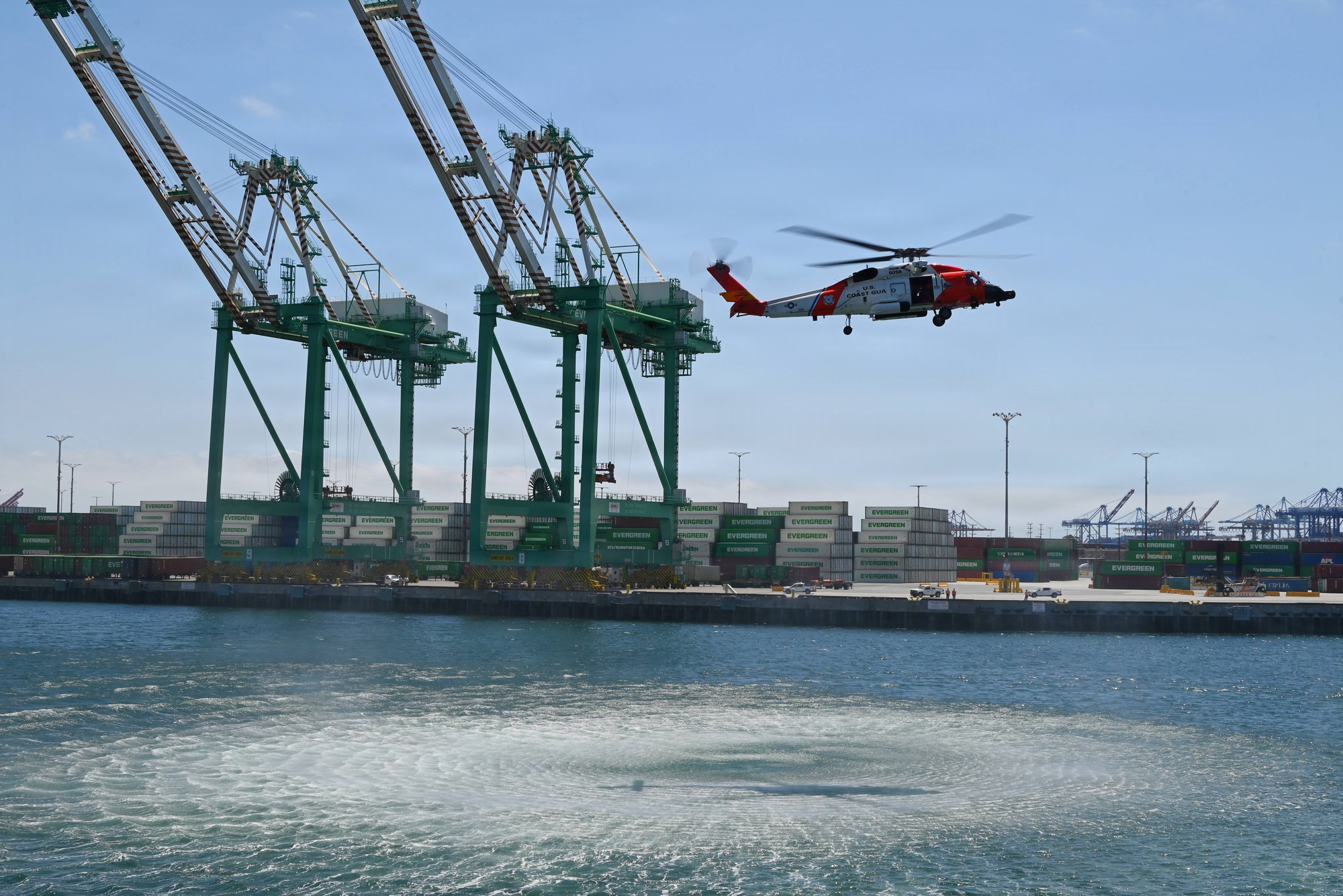
A Coast Guard search-and-rescue display is one of the easiest helicopter routines for a general audience to understand because every action supports a visible mission. A crew establishes a stable hover, lowers a rescue swimmer or simulated survivor, and demonstrates a hoist recovery while a safety boat remains nearby.
Coast Guard Air Station Atlantic City describes its public SAR demonstration as roughly ten minutes over water and notes that it can include lowering a rescue swimmer or qualified crew member. The unit also says demonstrations depend on operational requirements and require a cover boat. That is why a rescue sequence may disappear from an airshow schedule even after it has been announced: an actual mission always takes priority.
Source: U.S. Coast Guard SAR demonstration guidance.
What to watch during a helicopter demonstration
- Hover stability: Watch the aircraft relative to a fixed background point. Holding position in wind requires continuous corrections.
- Pedal turns: The helicopter rotates around its mast while remaining close to one spot.
- Quick stops: Forward speed converts into a steep nose-up deceleration before the aircraft settles into a hover or low-speed pass.
- Rearward and sideways flight: These movements reveal the control flexibility that distinguishes helicopters from fixed-wing aircraft.
- Rotor-disc attitude: The tilt of the rotor disc shows where the aircraft is directing thrust.
- Crew coordination: During hoist displays, the flight mechanic or hoist operator, rescue swimmer, pilots and safety boat work as one system.
The FAA’s rotorcraft guidance explains the underlying advantage: rotorcraft generate lift with rotating blades, enabling vertical takeoff, landing and hovering. The FAA Helicopter Flying Handbook is the best technical starting point for readers who want to understand flight controls and advanced maneuvers.
How to find helicopter displays at airshows
Start with the host event’s performer list rather than searching for one nationwide helicopter calendar. Useful labels include “helicopter demonstration,” “tactical demonstration,” “role demo,” “search-and-rescue demonstration,” “hoist demo,” “air assault,” and the exact aircraft type.
- Use our 2026 airshow schedule to identify an event.
- Open the organizer’s official performer or flying-display page.
- Search that page for helicopter, rotorcraft, SAR, Chinook, Black Hawk, Apache, Jayhawk or Dolphin.
- Recheck during the week of the show because military and rescue assets remain subject to operational availability.
- Confirm whether the aircraft is flying or only appearing in the static display area.
Military open houses, coastal airshows, Fleet Week events and major mixed-format shows are the most likely places to feature rotorcraft. Coastal events are especially well suited to Coast Guard hoist demonstrations because they can establish the required water and boat safety area.
Photographing helicopter flight displays
A shutter speed that freezes a jet can make a helicopter look unnaturally suspended. For visible rotor motion, begin around 1/250 to 1/500 second and pan smoothly; slower settings increase blur but reduce the percentage of sharp frames. During a hover or hoist, try a slower shutter once you have captured a safe, sharp sequence. Keep enough space around the aircraft for the rotor disc, smoke or hoist cable.
For more setup guidance, use our airshow photography guide. Always remain inside spectator areas and follow the organizer’s lens, tripod and bag rules.
Helicopter flight display FAQ
Are helicopter demonstrations included at every military airshow?
No. Participation depends on the host’s program, available crews, aircraft maintenance, weather and operational priorities.
Is an MV-22 Osprey a helicopter?
No. The FAA classifies tiltrotors within the broader rotorcraft category, while the Osprey operates as powered-lift rather than as a conventional helicopter. It can take off and land vertically, but its nacelles rotate for airplane-like forward flight.
Can an ordinary helicopter perform a loop or roll?
No. Aerobatics require an aircraft approved and prepared for the maneuver, an appropriately authorized pilot and an approved display environment. The spectacular Bo 105 routine should never be generalized to normal helicopter operations.
Why was a helicopter display cancelled?
Operational tasking, maintenance, crew availability, wind, visibility or the safety area can all remove a routine from the program. Coast Guard and military aircraft serve real missions first.
Bottom line: The best helicopter displays make precision visible. Whether the routine is a Bo 105 roll, a Chinook role demo or a Coast Guard hoist, look for control, crew coordination and mission-specific capability—not just speed.



Stay in the loop
Get the latest airshow spectacle updates delivered to your inbox.