Night airshows have gotten complicated with all the new pyrotechnic vendors and LED technology flying around. As someone who has stood in the dark at more after-sunset performances than I can count — from Oshkosh’s legendary Saturday night show to smaller regional events experimenting with drones — I learned everything there is to know about what makes a great night airshow tick. Today, I will share it all with you.
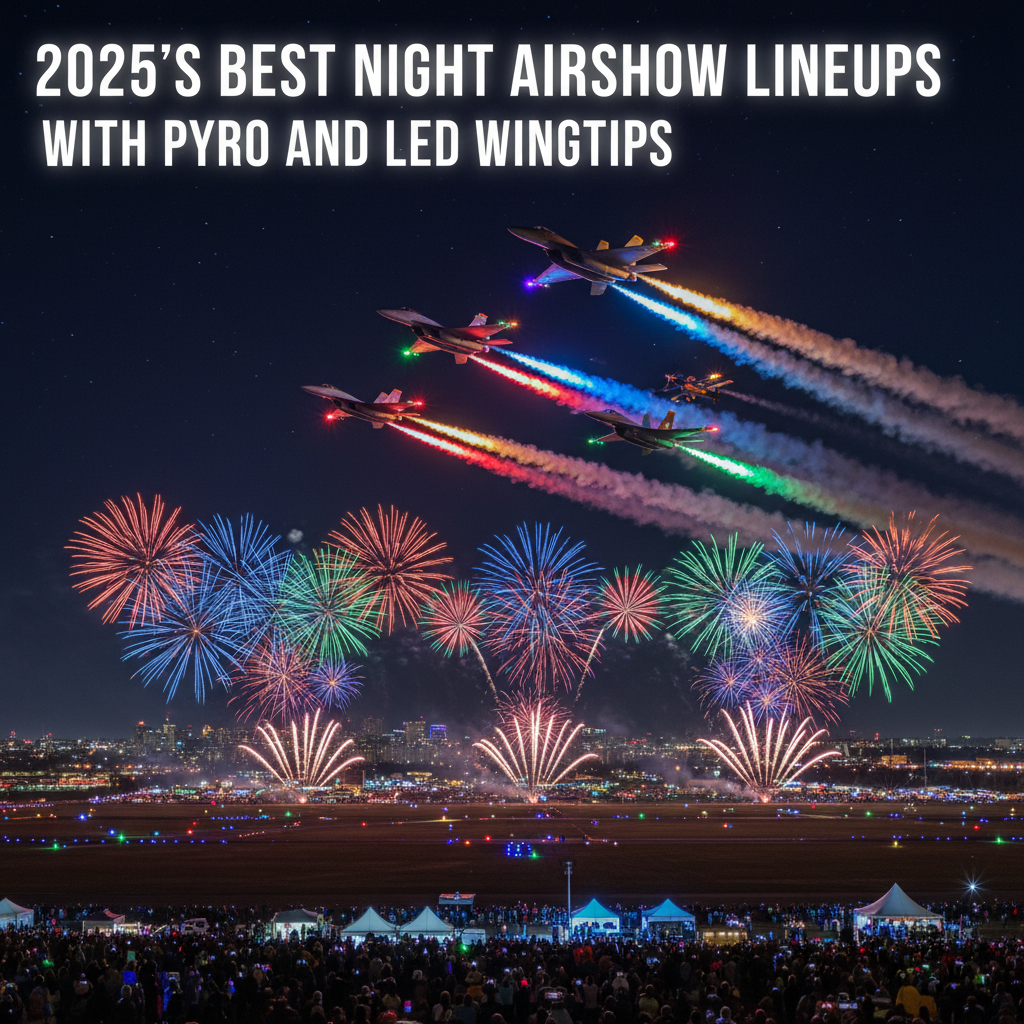
When the sun drops below the horizon and the first wingtip pyro ignites against a black sky, you are watching a completely different animal than a daytime airshow. The 2025 night airshow calendar features more fire, more drones, and more LED wizardry than any previous season. Here is where to find the best after-dark aviation this year.
Three Technologies Driving Night Shows
Probably should have led with this section, honestly. Modern night airshows rely on three spectacle technologies that have matured rapidly over the last decade.
Pyrotechnic systems: Wing-mounted firework launchers that throw trailing sparks, create ground-impact effects, and coordinate aerial detonations timed to music. The leading providers — Fireflies and Aerobatic Solutions among them — have refined these rigs to be both visually stunning and genuinely safe. The amount of engineering that goes into strapping controlled explosives to an airplane wing and then doing a rolling loop is staggering when you think about it.
LED light arrays: Programmable LED strips running along wings, fuselages, and empennages create color patterns, transitions, and synchronized displays visible from over a mile away. The best current systems produce 16.7 million colors and can be programmed note-by-note to a music track. I have watched the same aircraft fly a day routine and then a night LED routine and they barely look like the same machine.
Flame effects: Afterburner-simulation systems and dedicated flame generators produce dramatic fire trails that light up the entire crowd line. Matt Younkin’s Twin Beech and several aerobatic jets incorporate genuine flame generators that turn the airplane into a flying torch. The heat is something you can actually feel from the crowd line at closer shows.
2025’s Must-See Night Lineups
EAA AirVenture (Oshkosh, WI) – July: The Saturday night airshow remains the gold standard and it is not particularly close. Expect aerobatic performances loaded with pyrotechnic effects, a drone swarm segment, and the traditional wall of fireworks finale. Combine 500,000 aviation enthusiasts with a warm Wisconsin summer evening and you get an atmosphere no other night show can replicate. I have been to five of these and each one felt different.
Sun ‘n Fun (Lakeland, FL) – April: Florida’s premier spring event has expanded its night programming significantly to compete with Oshkosh. The Night Air Show features regional performers running full pyro loads alongside drone integration segments. The Florida humidity makes the smoke trails hang longer, which actually improves the visual effect.
California Capital Airshow (Sacramento, CA) – September: The twilight show transitions into full darkness performances, with west coast acts bringing routines you rarely see at eastern venues. The dry California air gives the LED displays a crispness that humid conditions tend to wash out.
Wings Over Houston (Houston, TX) – October: Texas does everything bigger and night pyrotechnics are no exception. The CAF’s twilight warbird passes leading into modern jets with flame effects creates a transition from history to spectacle that works remarkably well.
The Signature Night Acts
Fireflies Team: Multiple aircraft flying synchronized LED patterns while dispensing pyrotechnics in coordinated bursts. Their American flag formation is a crowd favorite for a reason — the colors are vivid and the timing is extremely tight.
Matt Younkin (Twin Beech): Probably the most unusual night act on the circuit. A vintage Beech 18 with wingtip flame generators throwing impossible fire patterns against the sky. The sound of those radial engines combined with the flames is genuinely surreal.
Gene Soucy and Teresa Stokes: Wing-walking combined with pyrotechnics. Teresa performs on the wing while Gene flies through firework barrages around them. The courage required to stand on a biplane wing in the dark while explosions happen around you is something I do not think I will ever fully comprehend.
Rob Holland: His MXS-RH deploys one of the most sophisticated LED and pyro combinations in the industry, performing tumbling maneuvers that seem impossible enough during daylight. At night with light trails tracing his flight path the effect is absolutely mesmerizing.
Photography Tips for Night Shows
That’s what makes night airshow photography endearing to us camera-toting aviation fans — it demands a completely different skill set than daytime shooting. Here is what actually works:
- ISO 3200-12800 depending on your sensor — modern cameras handle this noise level cleanly enough for great results
- Aperture wide open, f/2.8-5.6 depending on your glass
- Shutter speeds 1/250-1/500 to freeze the aircraft while still catching light trails
- Manual focus is essential — autofocus struggles badly with point-light sources against a dark sky
The best night airshow images I have taken used slightly slower shutter speeds around 1/60-1/125 to create intentional motion blur of the pyrotechnic trails while the aircraft itself stays relatively sharp. It takes some trial and error but the results are worth the experimentation.
Viewing Strategies for Night Performances
Unlike daytime shows where sun positioning matters for avoiding squinting, night performances are all about unobstructed sky views. Show center becomes the optimal position because you are watching light paintings against a dark canvas and parallax matters less.
Bring binoculars — I know that sounds counterintuitive for a light show, but the LED patterns and distant pyrotechnic details reveal textures invisible to the naked eye at crowd distance. I have seen a few folks bring night-vision optics for tracking aircraft between illuminated sequences, which honestly seems like overkill but they seemed to enjoy it.
The Experience Factor
What makes night shows special goes beyond the visual spectacle. Temperatures drop, the crowd mellows out from the frantic energy of the daytime performances, and there is something genuinely primal about watching controlled fire trace across a dark sky while engines roar overhead. Bring chairs, bring patience, and bring the willingness to just sit back and absorb it. Night airshows are where aviation entertainment gets closest to art.