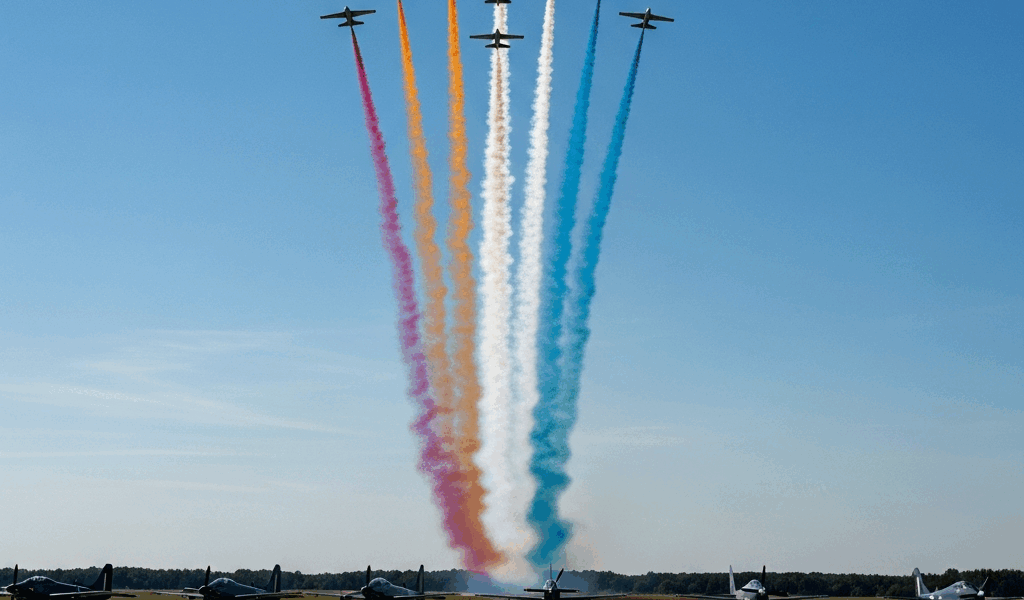
After 55 years of continuous operations and one final season of performances, Canada’s iconic Snowbirds aerobatic team will be grounded until the early 2030s. The Canadian Armed Forces officially confirmed the transition this summer, retiring the aging CT-114 Tutor jets in favor of the CT-157 Siskin II—a Swiss-manufactured Pilatus PC-21 turboprop trainer.
The move marks a historic shift for North America’s only all-Canadian military demonstration team. On July 11, 2026, the Snowbirds flew their final hometown show—precisely 55 years to the day after their very first performance in Moose Jaw, Saskatchewan. Tickets sold out in minutes.
End of an Era — The CT-114 Tutor Steps Down
Since 1971, the Canadair CT-114 Tutor has been the sole aircraft flown by the Snowbirds. Originally developed as a primary jet trainer for the RCAF in the early 1960s, the airframe was never engineered to last this long. The Department of National Defence extended the Tutors’ lifespan repeatedly, investing $30 million in cockpit upgrades in 2020 and originally planning to keep them flying until 2030. But feasibility studies revealed engineering challenges tied to the airframe’s age that made further extension unfeasible.
“As Canadians gather to watch the Tutors fly one final time, we will also celebrate the generations of pilots, technicians, engineers and support personnel who made the Snowbirds one of the most respected air teams in the world,” said Defence Minister David J. McGuinty during the May 19 announcement at 15 Wing Moose Jaw.
The 2026 season ran from May 24 through October 11, featuring 25 confirmed appearances across six Canadian provinces and three U.S. states. In their final performance, the signature nine-aircraft formation flew one last time in the classic red and white paint scheme that has become synonymous with Canadian aerobatics.
The CT-157 Siskin II — A New Chapter in Turboprop
The replacement aircraft, officially designated CT-157 Siskin II in Canadian military service, marks a significant departure: the Snowbirds will transition from jet to turboprop power. The Pilatus PC-21, though, stands among the world’s most capable turboprops—equipped with a 1,600-horsepower Pratt & Whitney Canada PT6A engine and capable of sustaining G-forces from +8G to −4G, demanding enough for advanced aerobatic display work.
The two-seat aircraft boasts a fully digital glass cockpit, head-up display, and embedded simulation systems. Designed to bridge basic training and front-line fast jets, it mirrors modern fighter handling characteristics while operating at turboprop economy. Every airframe destined for Canada includes Canadian-sourced components, including the powerplant and critical avionics elements.
As of May 2026, production and testing activities were advancing on Canada’s fleet of 19 CT-157s at Pilatus’s Stans, Switzerland facility as part of the broader FAcT (Future Aircraft Training) program. The formal contract for dedicated Snowbirds aircraft remained under negotiation, with McGuinty noting that procurement would proceed “as quickly as we possibly can.” The nine aircraft ultimately planned for the Snowbirds demo team will be drawn from this broader fleet.
The Grounding Period and What’s Next
The extended hiatus will span roughly 2026 through the early 2030s. During this period, the RCAF will continue supporting air shows and community events with other aircraft and personnel, but the distinctive nine-aircraft Snowbirds formation will be absent from Canadian and North American airshow calendars.
The new fleet will operate from 15 Wing Moose Jaw, Saskatchewan—the team’s traditional home. The Snowbirds Alumni Association has launched the “No Pause – Keep the Snowbirds Flying” campaign, encouraging Canadians to advocate for solutions that might accelerate the transition or reduce the gap between teams. Over 25,000 postcards have been sent to Parliament Hill.
“This decision was not taken lightly,” said Lieutenant-General Jamie Speiser-Blanchet, Commander of the Royal Canadian Air Force. “While this marks the end of one chapter, it opens the door to what comes next.”
The Snowbirds will return. When they do, the red and white will fly again—this time powered by turbines instead of turbojets, but with the same precision, pride, and Canadian spirit that has defined the team for more than half a century.
Sources
- CBC News Canada — Snowbirds Final Hometown Show
- Canadian Armed Forces Official Announcements — May 2026
- Department of National Defence Press Releases — CT-157 Siskin II Procurement
- SkyAlyne / FAcT Program Documentation
- Snowbirds Alumni Association — Keep the Snowbirds Flying Campaign
n




Stay in the loop
Get the latest airshow spectacle updates delivered to your inbox.