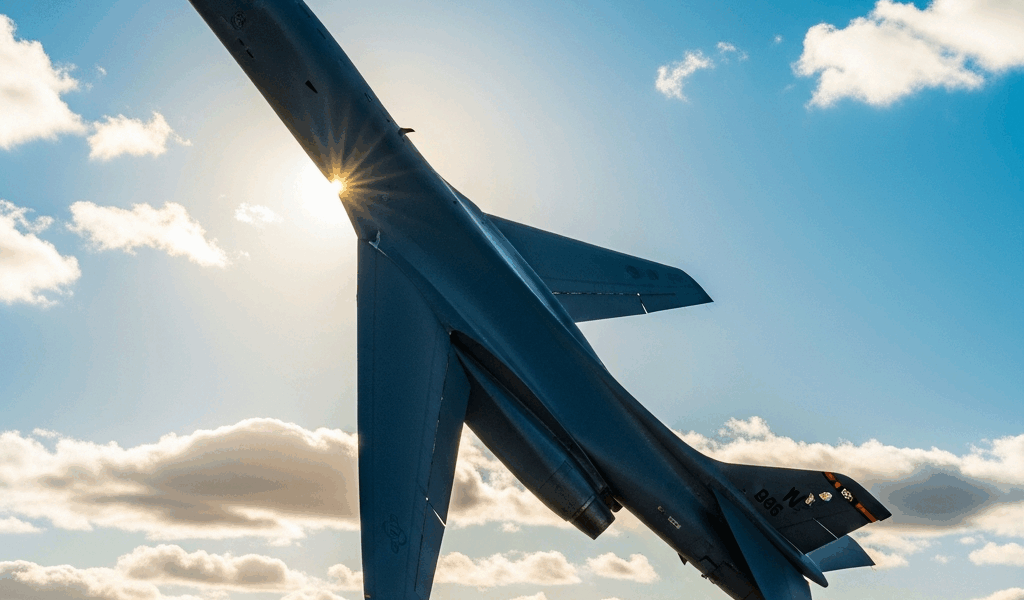
Why the B-1 Lancer Matters at Airshows
When that swing-wing bomber lines up for takeoff, people lose their minds. The sound alone—a deep, bone-rattling roar that you feel in your chest—stops conversations mid-sentence.
Here’s the thing about the B-1 Lancer: it’s genuinely rare at public airshows. The B-52 Stratofortress? Shows up at dozens of events yearly. The B-2 Spirit has become slightly more visible over the years. But the B-1? It shows up selectively, and the Air Force treats these appearances as special events. When they happen, serious enthusiasts plan around them. The aircraft measures 146 feet long with a 137-foot wingspan in fully extended position—that’s roughly the size of a commercial airliner, except sleeker and infinitely more menacing. Seeing it taxi down the runway or perform a low-level pass absolutely justifies the trip.
Probably should have opened with this section, honestly, but there’s a practical reason for the scarcity. The B-1 fleet operates at critical capacity. These bombers are deployed constantly—the Middle East, the Pacific theater, training rotations. Getting one airside for a weekend event means pulling it from operational readiness. That constraint makes every appearance newsworthy and worth your time to witness.
2025 B-1 Lancer Airshow Schedule
I’ve compiled the following list based on official Air Force public affairs announcements, airshow websites, and confirmed participation notices as of late 2024. Keep in mind that scheduling remains fluid, so I’ve included confidence levels and notes on verification.
- Nellis Air Force Base Aviation Nation — November 2025 (Las Vegas, Nevada)
Confidence: Very High. Nellis hosts the B-1 contingent regularly, and Aviation Nation consistently features the aircraft. Typical dates run mid-November. This is one of the most well-attended airshows in the US—over 400,000 spectators show up. Check nellis.af.mil for official confirmation in September 2025. - Joint Base San Antonio Aerospace Expo — April 2025 (San Antonio, Texas)
Confidence: High. Lackland Air Force Base and Randolph Air Force Base participate annually. B-1s from the 7th Bomb Wing at Dyess AFB (about 200 miles northeast) have appeared in previous years. Verify at jbsa.mil in February 2025. - Offutt Air Force Base Airshow — June 2025 (Omaha, Nebraska)
Confidence: Moderate-to-High. Offutt hosts the Air Force Global Strike Command headquarters, which makes it a strategic location for bomber displays. B-1 appearances aren’t guaranteed annually, but the base has featured the aircraft multiple times. Monitor official.af.mil announcements starting April 2025. - Vance Air Force Base Airshow — September 2025 (Enid, Oklahoma)
Confidence: Moderate. Vance is primarily a training base, though it occasionally hosts multi-service static displays. B-1 appearances depend on operational tempo and availability. Check vance.af.mil in July 2025. - Andrews Air Force Base Joint Service Open House — May 2025 (Joint Base Andrews, Maryland)
Confidence: Moderate. This is one of the largest airshows in the eastern US, but B-1 participation varies year to year. The proximity to DC and strategic significance make it appealing for Air Force representatives. Confirm via the official event website in March 2025.
Why these five? They’re bases where the B-1 is permanently stationed (Dyess AFB in Texas, Ellsworth AFB in South Dakota), strategically important command hubs, or events with massive draw and established military relationships. The 2025 calendar is tighter than usual due to operational commitments, so these represent the most likely venues based on historical patterns and current Air Force statements.
Where to Position Yourself for the Best B-1 Views
Getting the right seat is everything. I learned this the hard way at a 2019 show when I ended up directly behind a wing of temporary bleachers, watching a B-1 pass through a gap in the crowd. Here’s the real intel.
For static displays: Arrive early — like 6 a.m. early if it’s a Saturday — and position yourself at a 45-degree angle to the aircraft’s nose. This captures the full fuselage, the distinctive variable-sweep wings, and the canopy detail. Avoid standing directly in front or behind; the best photos and views come from the three-quarter perspective. If you’re photographing, bring a wide-angle lens. The B-1 at rest is 146 feet of engineering, and you need distance to frame it properly.
For flying demonstrations: Predicting the flight path is the hardest part. Talk to ground crews, check the airshow schedule (usually published the morning of the event), and position yourself perpendicular to the expected runway approach or departure line. B-1 demos typically include a low pass—usually around 500 feet altitude, sometimes lower—and possibly a climbing turn. Stand on the side of the flightline where the sun is behind you and the aircraft is backlit. This reduces glare and sharpens detail.
For sound and tactile experience: Bring earplugs or noise-reducing headphones that still let you hear announcements. The B-1’s four afterburning General Electric F101-GE-102 engines produce approximately 128.8 decibels at takeoff. That’s louder than a jet engine at full throttle standing 100 feet away. Honestly, wearing hearing protection doesn’t diminish the experience — it enhances it because you won’t spend the next week with ringing ears.
Seating strategy: Premium seating areas often offer better sightlines but come with a cost — typically $25 to $75 per seat. General admission runs $10–$20 and works fine if you’re willing to stand and move around. For multi-day shows, day two or three often has smaller crowds, which means better viewing positions for afternoon demonstrations. Also bring a chair. You’ll be there five to eight hours.
B-1 Lancer Facts Spectators Should Know
- Speed: Maximum velocity is Mach 1.25 in low-altitude terrain-following mode. That’s over 950 mph. At altitude, it can exceed Mach 2. You won’t see supersonic runs at airshows — too dangerous, too fuel-intensive — but the aircraft will move fast enough that you’ll understand why it’s called a “strategic bomber.”
- Payload: The B-1 can carry 75,000 pounds of ordnance or munitions. That’s equivalent to a loaded dump truck’s weight, suspended under the airframe. The weapons bay spans 38 feet. This payload capacity is why adversaries take B-1 deployments seriously.
- Variable-sweep wings: Watch closely when the B-1 taxies or performs maneuvers. The wings are mechanically programmed to sweep back (retract) at high speed for aerodynamic efficiency and sweep forward (extend) for stability at low speeds and landing. You might catch this happening during demonstrations.
- Crew: Four officers pilot and operate the B-1 — two pilots in front, two weapons officers in back. The cockpit is sophisticated enough that you’ll see red reflections off canopy glass from the heads-up displays and instrumentation.
- Nickname: The “Bone” (slang derived from “B-One”) is the affectionate call sign among flight crews. You’ll hear commentators use it interchangeably with “Lancer.”
- Deployments: The B-1 fleet operates primarily in the Middle East and the Indo-Pacific region. A typical deployment rotation runs six months, with aircraft cycling through Kandahar, Qatar, and Japan-based locations.
How to Confirm B-1 Appearances Before You Go
Don’t show up to an airshow hoping the B-1 will be there. Verification is crucial.
- Official airshow websites: Each of the events listed above maintains a schedule of confirmed participants. Look for it 4–6 weeks before the event. Search “[airshow name] 2025 schedule” or “[base name] airshow lineup.”
- Air Force public affairs: Contact the base directly. Call the public affairs office (usually listed on the base website) and ask straight up: “Is a B-1 Lancer scheduled for the [date] airshow?” This is the most reliable source.
- Military enthusiast forums: Websites like Airliners.net, aviationforum.com, and various Facebook groups dedicated to military aviation often have members who track B-1 movements and upcoming appearances. These communities share news quickly and accurately.
- Follow USAF social media: The official Air Force account (@usairforce on Twitter/X) and individual command accounts post airshow schedules. Search for posts tagged #AirShow or #AviationNation in the months leading up to major events.
- Subscribe to airshow mailing lists: Most major shows offer email newsletters. Sign up 2–3 months before the event to receive aircraft lineup updates, schedule changes, and weather-related announcements.
The B-1 Lancer in 2025 remains one of aviation’s most impressive sightings. Plan ahead, confirm appearances officially, and position yourself strategically. You’ll witness an aircraft that represents three decades of American aerospace engineering and operational dominance. That’s worth the effort.


Stay in the loop
Get the latest airshow spectacle updates delivered to your inbox.