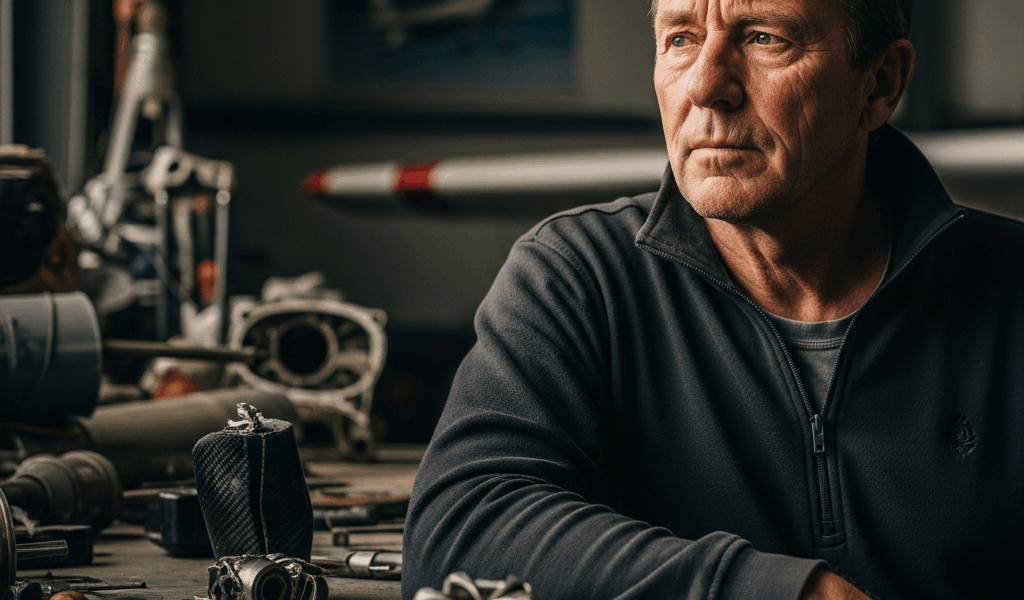
What Happened to Wayne Handley — Airshow Pilot, Crash Survivor, and the Man Who Came Back
If you’ve ever searched for what happened to Wayne Handley, the airshow pilot who flew the Turbo Raven, you’ve probably hit the same dead ends I did — a few forum posts, a buried NTSB record, and one local newspaper article from Salinas that’s sitting behind an archive paywall. I spent a long time piecing this story together from accident reports, airshow community interviews, and whatever contemporaneous coverage survived the early internet era. What I found was genuinely one of the most remarkable comeback stories in aviation history, and I have no idea why it isn’t talked about more. Shattered aorta. Three inches of height, gone. Back in the cockpit inside of a month. And then, four years later, he flew back to the exact field where it all went wrong.
That’s the short version. Here’s the full one.
The Turbo Raven — Wayne Handley’s Revolutionary Aircraft
Most airshow performers in the late 1990s were flying variants of aircraft that already existed — modified Extras, Sukhoi Su-26s, Pitts Specials. Wayne Handley built something else entirely. The Turbo Raven was a single-seat aerobatic aircraft of his own design, powered by a Pratt & Whitney Canada PT6A turboprop engine — the same engine family you find bolted to King Airs and agricultural turboprops, not typically to an airshow toy the size of a large go-kart.
The aircraft debuted publicly in 1998, and the reaction from the airshow community was immediate. Not just because it looked unusual — low wing, stubby fuselage, almost aggressive in its proportions — but because of what Handley was doing with the propeller. The PT6A is a reverse-flow engine, and the Turbo Raven was configured to use reverse-pitch propeller settings as part of the actual aerobatic routine. During approach and certain maneuvers, Handley could deploy reverse pitch to create dramatic deceleration effects — the kind of sudden, almost violent speed scrubbing that no piston-powered aerobatic aircraft could replicate.
To give you a sense of what that looked like from the ground: imagine an aircraft appearing to fall out of the sky vertically, braking hard against its own prop wash, then recovering just above the runway threshold. Crowds did not know what they were watching the first time they saw it. Some of them didn’t believe it was intentional.
Why the Turboprop Mattered
The PT6A gives a pilot options that piston engines simply don’t. The power delivery is different — smoother torque curve, faster throttle response at altitude, no magnetos to worry about, and the ability to run the prop in beta (near-flat or reversed blade angle) while the engine itself is still producing power. Handley had essentially engineered a flight control surface out of the propeller disc. That’s not an exaggeration. The prop could act as a brake, a lift modifier, and a visual spectacle all at once.
The aircraft weighed in under 1,000 pounds empty, and with the PT6 pushing somewhere in the neighborhood of 500 shaft horsepower, the power-to-weight ratio was extraordinary. For reference, a Pitts S-2C Special — already considered a seriously powerful aerobatic aircraft — runs a 260-horsepower Lycoming. The Turbo Raven had nearly twice that in a lighter airframe.
Handley had spent years designing the aircraft. He wasn’t a newcomer — he had a long career as a military pilot and had already established himself as a competitive aerobatics performer before the Turbo Raven project began. This was not a stunt. It was an engineering program. The 1998 debut represented years of design work, prototype testing, and iterative refinement.
Probably should have opened with this section, honestly, because without understanding what the Turbo Raven actually was, the crash doesn’t fully make sense.
The Crash at Salinas — October 3, 1999
Exactly one year after the Turbo Raven’s public debut, Handley was performing at the Salinas Airshow in California. It was October 3, 1999. The weather was fine. He was executing an approach sequence that he had performed many times — the kind of dramatic, decelerating low pass that had become his signature.
During the approach, the engine failed to deliver the expected power output. The exact sequence of events is where Handley’s account and the NTSB findings diverge slightly, and it matters.
What the NTSB Said
The National Transportation Safety Board determined the probable cause involved a failure related to the propeller control system — specifically, that the propeller entered or remained in a reverse-pitch configuration at a point in the approach where it should have transitioned out. With the prop in reverse pitch and insufficient power being delivered, the aircraft could not accelerate through the critical speed band. It was below flying speed with no realistic way to regain it in the altitude available.
The NTSB report cited the propeller control mechanism and noted contributing factors related to the aircraft’s experimental certification status. The Turbo Raven was flying under experimental airworthiness — it was a one-of-a-kind aircraft, and the systems governing prop pitch transitions were not certified production hardware.
Handley’s Account
Handley, in interviews after his recovery, described the problem differently in emphasis if not in fact. His account focused on the engine’s failure to respond — he called for power, and the power wasn’t there. The prop pitch issue was downstream of that, in his framing. Whether the engine failed first and trapped him in a regime where reverse pitch became catastrophic, or whether the pitch control failed and then prevented any recovery regardless of engine response — the outcome was the same either way.
The aircraft came down hard at the airfield. Handley survived the impact, which is remarkable by any measure given what the deceleration did to his body.
The Injuries
His aorta was shattered. That sentence doesn’t fully land until you understand what it means surgically — the aorta is the primary outflow vessel from the heart, roughly 2.5 centimeters in diameter at the ascending section, and a rupture or severe tear is fatal in the majority of trauma cases within minutes. The fact that Handley reached a trauma center alive, let alone survived, required both rapid emergency response and a degree of anatomical luck that surgeons probably couldn’t fully explain.
His L2 vertebra — the second lumbar vertebra, positioned in the lower back roughly at the level of the navel — was destroyed in the impact. Not fractured. Destroyed. The compressive force of the crash essentially collapsed it. As a result, Wayne Handley lost approximately three inches of height. That’s a number that sounds almost abstract until you think about what it means structurally — three inches of spinal column, compressed out of existence in a fraction of a second.
He was 57 years old at the time of the crash.
The Recovery Nobody Expected
Driven by stubbornness, surgical skill, and what can only be described as an adversarial relationship with the concept of stopping, Wayne Handley returned to flight status within approximately one month of the crash. Let me be clear about that timeline: less than thirty days after surgeons fused what remained of his lumbar vertebrae using bone graft material — in a procedure that involved harvesting fragments and essentially building a structural replacement for the destroyed L2 — he was back in an aircraft.
His doctors told him not to. That’s not a detail that needs dramatizing. He was advised, directly, that returning to flight in that timeframe was medically inadvisable. He returned anyway.
The Spinal Fusion
The surgical repair involved fusing the vertebrae above and below the destroyed L2 using bone material. This creates a single rigid segment in the lumbar spine where there were previously two or three articulating joints. The tradeoff is stability at the cost of mobility — a fused lumbar spine can support weight and resist compressive forces, but the range of motion in that segment is permanently reduced.
For an aerobatic pilot, that’s not a trivial limitation. High-g maneuvers load the spine compressively and in shear. Negative-g maneuvers — outside turns, inverted flight — do the reverse. A fused lumbar section means those loads are distributed differently, and the adjacent segments above and below the fusion have to absorb more. Handley would have known all of this. He returned to flying anyway.
The Mental Side
I’ve made the mistake in past writing of underplaying the psychological component of coming back to an aircraft after a crash. It’s easy to focus on the physical recovery because it’s quantifiable — you can measure bone density, count days, document surgical outcomes. The mental reconstruction required to get back into a cockpit after a near-fatal accident in that cockpit is not quantifiable, and it doesn’t follow a schedule.
What Handley described in later interviews was a deliberate, methodical approach to processing the crash — understanding exactly what failed, and why, before he flew again. This is a pattern common to pilots who successfully return after accidents and uncommon in those who struggle. The goal is not to suppress the memory. The goal is to convert it from a traumatic intrusion into technical information. What broke. Why it broke. What would be different.
By 2001, Handley was flying in an airshow support capacity — assisting other performers, maintaining currency, staying in the community. He wasn’t performing solo aerobatics yet, but he was in the air. That matters.
What “Back Flying in a Month” Actually Means
There’s a tendency to read that detail as heroic in a reckless way. It’s worth complicating that reading. Handley was a former military aviator with decades of flight time. His medical self-assessment had a professional foundation that most people lack. He wasn’t ignoring the risk — he was making a calculated judgment that his doctors, operating from a conservative baseline appropriate to general patients, were not making the same calculation he was. Right or wrong, that’s a different thing from simply ignoring medical advice.
Return to Salinas — 2003
Four years after the crash, Wayne Handley returned to the California International Airshow at Salinas. The same event. The same field. The place where the Turbo Raven came down and he lost three inches of his spine.
In the airshow community, this kind of return carries weight that is difficult to explain to people outside it. Airshow fields are not generic locations. Performers have memories attached to specific runways — the show where they nailed a new maneuver for the first time, the show where something went wrong, the show where they watched a colleague get hurt. Salinas 1999 was a specific, named trauma in Wayne Handley’s life, and returning to perform there was not a casual decision.
What the Return Meant
The 2003 Salinas appearance was covered by the Salinas Californian — the local newspaper piece that now sits behind the archive paywall that frustrated so many people searching for this story. Based on contemporaneous reports and community accounts, Handley’s return was treated as significant by both the airshow organizers and the crowd. He was not flying the Turbo Raven — that aircraft was gone. He was performing in a different aircraft, having rebuilt not just his body but his entire performance program from scratch.
That distinction is important. The Turbo Raven was a one-of-a-kind aircraft that he had spent years designing. It was destroyed in the crash. There was no replacement waiting. Returning to Salinas meant returning without his signature aircraft, without the routine that had defined his late career, and with a spine that was structurally different from the one he flew with before the crash. He rebuilt everything.
Coaching and Safety Advocacy
After 2003, Handley increasingly shifted his focus toward coaching and safety work within the airshow community. This is a transition that many senior performers make eventually, but the timing and the motivation behind it in Handley’s case were specific. He had direct, visceral experience with what happens when an experimental aircraft’s systems fail during a demanding low-level maneuver. That experience made him useful in ways that went beyond flying.
He became involved in discussing airshow safety protocols — the kind of work that doesn’t generate headlines but that quietly shapes how performers train, how they assess risk, and how they think about failure modes. The airshow community in the United States operates under FAA oversight with specific waiver requirements for low-level aerobatics, and safety culture within that community evolves partly through informal knowledge transfer between senior performers and newer ones. Handley contributed to that transfer in a meaningful way.
His engineering background — the same background that produced the Turbo Raven — was relevant here. He wasn’t just describing feelings about risk. He was describing systems, failure modes, decision trees.
Why This Story Matters
Wayne Handley’s story sits at the intersection of engineering ambition, physical catastrophe, and genuine human resilience. The Turbo Raven was a legitimate aeronautical innovation — a purpose-designed turboprop aerobatic aircraft with capabilities that production aircraft still don’t match today. The crash that destroyed it also nearly destroyed him. The recovery, and especially the return to Salinas four years later, is the kind of narrative that should be much more widely known than it is.
The reason it isn’t comes down to timing and medium. The crash happened in 1999. The return happened in 2003. Neither event occurred in the era of YouTube, social media, or persistent online aviation journalism. The coverage exists — in print archives, in NTSB databases, in the institutional memory of the airshow community — but it hasn’t been assembled into a single accessible account until now.
He lost three inches of height. He was back in a cockpit within a month. He returned to the exact airshow where he almost died. If that story had happened in any other entertainment or sports domain, it would be a documentary. In the small, specialized world of airshow aviation, it’s a buried newspaper article and a few forum posts.
Now you know the full version.

Stay in the loop
Get the latest airshow spectacle updates delivered to your inbox.