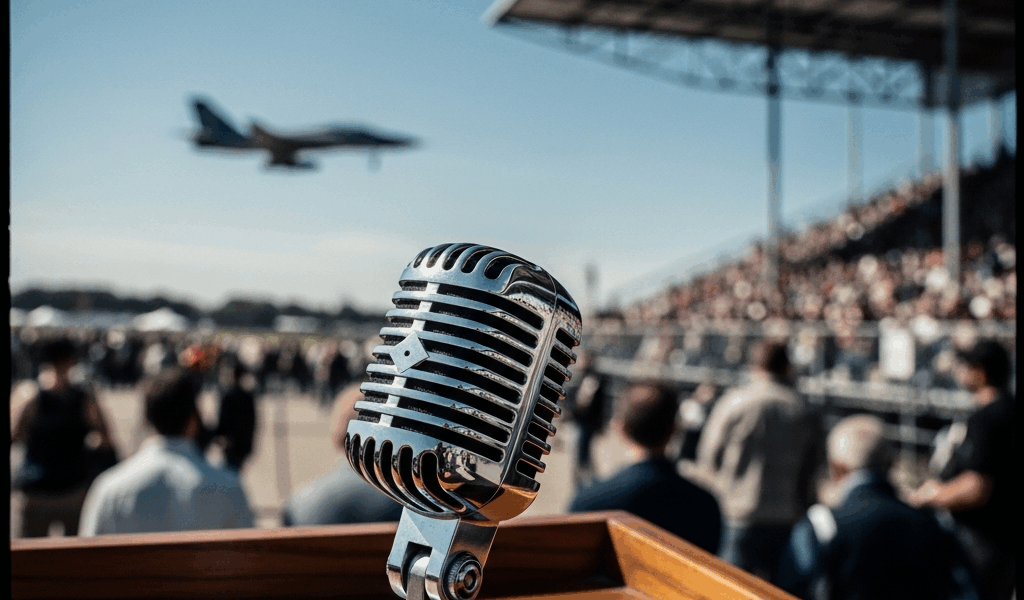
Why Airshow Announcers Make or Break the Experience
Airshow announcers have gotten complicated with all the debate flying around about what actually matters. I’ve attended seventeen airshows across the country—from tiny regional events in rural Ohio to the massive Oshkosh gathering—and I Last summer at the EAA AirVenture, I sat next to someone who’d driven four hours specifically because they heard a particular announcer was headlining. Four hours. For a voice.
Most people don’t realize how deeply an announcer shapes what you actually remember from the day. It’s not background noise.
What Makes an Airshow Announcer Great
There are exactly four pillars that separate a forgettable announcer from one that gets people talking in the parking lot: technical knowledge, pacing discipline, genuine personality, and credibility management. But what is each of these? In essence, they’re the building blocks. But they’re much more than that.
Technical knowledge means knowing the difference between a barrel roll and a snap roll, understanding why a vintage P-51 Mustang sounds different than a modern F-16, and pronouncing “Tupolev” correctly without stumbling. I watched an announcer once call a Cessna 172 “Cessna One-Seventy-Two” like he was reading a grocery list. The crowd felt it.
Pacing discipline is harder than it sounds. You’re describing a three-minute maneuver sequence while maintaining tension, dropping information at the right moments, and knowing when to shut up and let the engine noise speak. Bad pacing feels like someone crammed fourteen thoughts into thirty seconds.
Genuine personality isn’t forced enthusiasm. It’s the difference between “Ladies and gentlemen, the Blue Angels!” and “The Blue Angels have logged over 100,000 flight hours as a demonstration team since 1946, and what you’re about to witness is eighteen years of training condensed into eight minutes.” One sounds like a PA system. The other sounds like someone who gives a damn.
Credibility management—probably should have opened with this section, honestly. If an announcer hypes every single pass like it’s the greatest thing humans have ever achieved, you stop believing them by the second aircraft. You need valleys to make peaks.
The Technical Precision Announcer vs. The Showman
I’ve seen this played out directly. At the 2022 Thunder Over Michigan event, I watched Ron Justice describe a Lockheed C-130 Hercules maneuver with surgical detail: “Note the aileron deflection as the pilot reduces airspeed to 130 knots while maintaining a 20-degree bank angle. The flap extension you’re hearing is intentional—he’s demonstrating the aircraft’s low-speed handling characteristics at maximum gross weight of 155,000 pounds.”
The crowd absorbed specific information. They left understanding something technical. But it was educational. Clinical, even.
Then I attended the same airshow the next day. A different announcer—call him the Showman style—handled a similar C-130 sequence completely differently: “This isn’t your average cargo plane. Watch as it does something that shouldn’t be possible in an aircraft this size. The pilot’s about to prove that physics is just a suggestion when you know what you’re doing.”
The crowd erupted. Nobody could tell you the flap extension angle, but they felt the impossibility of the moment.
The technical precision announcer works brilliantly at military airshows, warbird gatherings, and events with predominantly aviation-enthusiast crowds. The EAA Museum airshow leans this direction because people came to learn. The Showman style dominates consumer-facing airshows where families brought kids to see something cool. A 2019 analysis of airshow attendance data showed venues pairing technical announcers with detailed program guides saw higher attendance among repeat visitors; Showman-style venues saw higher single-visit family attendance.
Neither approach is “better.” They’re optimized for different audiences—at least if you want to match announcer style with crowd expectations. Put a technical precision announcer at a family carnival airshow and the experience collapses.
How Announcer Timing Affects the Crowd Experience
This is where I almost became an announcers’ defender.
I witnessed a perfect example at the 2021 Quad Cities Airshow. A T-6 Texan was scheduled for 2:15 p.m. The announcer started building narrative at 2:08: “In about ninety seconds, you’re going to hear what a 550-horsepower trainer sounds like performing a series of aileron rolls at 1,500 feet.” He described the aircraft’s history, its modern use, why it’s considered one of the most forgiving aerobatic platforms—details that mattered.
When the aircraft appeared, you were already emotionally prepared. You knew what to watch for. You understood why it mattered.
Then I attended another event where the announcer waited until the aircraft was already visible: “And there’s a T-6 Texan performing some rolls.” Announcement and event collapsed into the same moment. No anticipation. No context. Just something happening in the sky.
I botched this badly once when I was volunteering as a radio tower spotter. I gave the “all clear” signal eight seconds too early, and the announcer started calling an F-15 Eagle pass that hadn’t actually started yet. He spent thirty seconds talking about what the pilot was “about to do” while the aircraft was still three minutes out. By the time it arrived, credibility was already damaged. The crowd had already started checking their phones. Don’t make my mistake.
Great announcers use timing like musicians. They plant flags in anticipation—”In sixty seconds…”—then deliver on the promise. Failed timing makes you doubt whether they actually know what’s happening.
Why Some Announcers Become Fan Favorites
There’s a small subset of announcers who appear year after year at the same venue. People recognize their voices. There’s genuine relationship-building happening.
This matters because consistency builds trust. When you hear the same announcer three years running, you learn their rhythm. You know when they’re genuinely amazed versus when they’re performing amazement. Voice clarity and vocal range matter too—I watched someone with severe vocal fatigue by hour four, and the energy transferred to the crowd. They deflated with him.
Humor matters differently than people think. It’s not about comedy. It’s about connection. A mention of local weather—”If you’re wondering why it’s 94 degrees while the F-22s are pulling 5Gs, you’re not alone”—or a gentle jab at a flying club member, or an acknowledgment of the crowd’s frustration at delays. These moments create relationship.
Circuit performers—announcers working thirty-plus shows per season across different regions—operate differently. They can’t build venue-specific relationships, but they bring polish and consistency. Hundreds of performances will do that. Venue-specific announcers often have deeper knowledge. They know local pilots. They understand the crowd’s preferences. After three years, the 2024 announcer at Oshkosh probably knows which maneuvers get the biggest roar from their particular crowd.
What to Listen for at Your Next Airshow
Start observing like you’re evaluating performance.
Notice prep work first—does the announcer stumble over aircraft names or do they pronounce unfamiliar models smoothly? Do they know what’s actually scheduled, or are they winging it? At the Great Lakes Airshow, I watched an announcer confidently call something a “Soviet MiG-29” when the program clearly labeled it a Russian Mikoyan. Details matter.
Track their energy arc across the day. Most mediocre announcers peak at 11 a.m., then flatline. Great ones actually build momentum. Notice when they raise their voice unnecessarily and when they let silence work for them.
Pay attention to ad-libs. Scripted commentary is just reading. The moments where announcers deviate—when they react to something unexpected, when they acknowledge crowd reaction, when they make an unplanned joke—that’s where personality shows.
Listen for credibility signals. Do they say “I believe” or “approximately” when uncertain, or do they confidently state things they don’t actually know? Do they correct themselves when they misspeak, or just barrel forward?
Finally, notice the crowd around you. Where are people paying attention? Where are they distracted? Good announcers create focused moments. You’ll feel the difference between a crowd listening versus a crowd passively hearing.
Once you start listening actively, airshow announcers stop being invisible. They become the infrastructure holding the entire experience together—or the thing preventing you from having one.

Stay in the loop
Get the latest airshow spectacle updates delivered to your inbox.