The Thunderbirds Aren’t Your Local Airshow’s Problem
I spent three summers chasing regional airshows across the Midwest, and I learned why Thunderbirds skip most of them — the hard way. Every June, I’d drive two hours to whatever airshow my local chamber of commerce was promoting, scanning the lineup hoping to see those iconic F-16s. Never there. Eventually, I stopped assuming the airshow organizers were incompetent and started asking actual questions.
Here’s what nobody wants to admit: your regional airshow probably never even got to the negotiation table. The Thunderbirds’ schedule gets locked 12 to 18 months in advance, and the slots fill based on criteria that have nothing to do with how much your local event committee wants them there.
When I finally talked to an air show director who’d been trying to land the Thunderbirds for a decade, he described the submission process like applying to an Ivy League school — you get one shot, and the acceptance rate isn’t much better. The team receives hundreds of requests annually. They accept maybe 40 to 50.
How Many Dates Does the Thunderbirds Team Actually Have
Let’s start with the real numbers. The U.S. Air Force Thunderbirds typically perform at 40 to 50 airshows per calendar year, spread across an eight to ten-month window. That sounds like plenty until you realize there are over 200 airshows happening annually across the United States.
Do the math: if 200+ airshows want the Thunderbirds and the team can only show up to 50, you’re already looking at a 75% rejection rate before the team even considers whether your airshow meets their criteria.
The schedule is tighter than it looks on paper. The team operates under a mandatory training regimen — between June and August, many years include a three to four-week stand-down period where demo flights stop entirely and the pilots focus on proficiency training. You don’t get to ignore that window just because Tulsa’s airshow is July 15th.
Winter months present another scheduling wall. Most of the team’s performances cluster from March through November. Cold-weather flying restrictions, base commitments, and pilot rotation cycles all compress the available calendar. That’s not arbitrary.
Why Bigger Cities Get Priority Over Regional Events
Probably should have opened with this section, honestly. The selection process isn’t mysterious once you understand the Thunderbirds operate under Air Force directives, not just market forces.
Population reach matters first. The team prioritizes markets where they can reach 500,000+ people either at the airshow itself or through media coverage. A major metropolitan area’s airshow — say Chicago’s or Las Vegas’s — guarantees that threshold. A regional event in a town of 80,000? That’s a harder sell.
Military recruitment zones come next. The Air Force uses the Thunderbirds as a recruiting tool. If the Air Force has identified a region where pilot or enlisted recruitment is struggling, an airshow in that market becomes strategically valuable. That’s why you’ll see the team cluster around Air Force bases and their surrounding regions some years.
Sponsorship budgets tip the scales too. Major airshows have corporate backing and pre-negotiated financial commitments. Phoenix Sky Harbor’s airshow isn’t just a regional event — it’s a nationally recognized show with major sponsors locked in years ahead. Those sponsors expect the Thunderbirds to appear. Smaller shows operate on tighter margins. An airshow that can only guarantee $40,000 in sponsorship support isn’t as attractive as one offering $200,000.
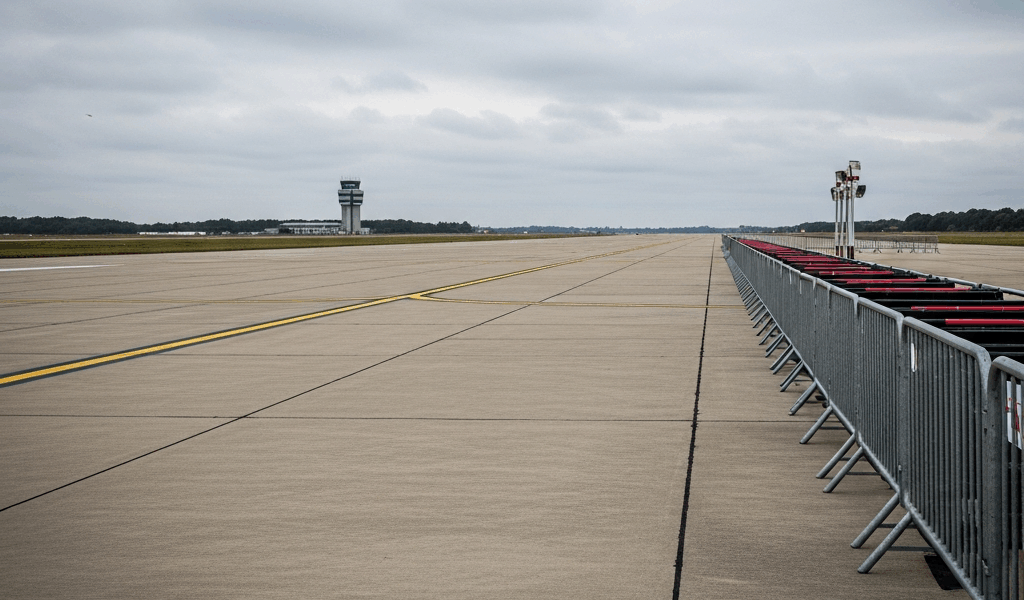
The venue itself plays a role. The Thunderbirds need runways that support six F-16s plus support aircraft. That runway needs to be at least 8,000 feet long and wide enough to handle the team’s operational requirements. A smaller regional airfield might have the space but lack the ramp capacity, fuel infrastructure, or emergency services the team requires. I learned the details when a friend who works ground ops at a regional airport told me they were disqualified before even submitting a formal request.
The Budget Reality Nobody Talks About
Post-2020 budget cuts fundamentally changed how the Thunderbirds allocate their schedule. I don’t mean abstract budget shrinkage — I mean specific, measurable constraints on fuel spending and per diem costs.
Deploying the Thunderbirds to an airshow isn’t like sending a single aircraft. You’re moving six F-16s, a support C-130 transport, maintenance crews, logistics personnel, and medical staff. For a three-day airshow, that’s potentially 40+ personnel traveling, staying overnight, and eating per diem.
Fuel costs alone for that C-130 to fly cross-country and back run into five figures. Add in the F-16 demonstration flight fuel — JP-8 jet fuel, roughly $2 to $3 per gallon depending on the fiscal year — ground transportation, lodging, and meals. A single deployment costs the Air Force $150,000 to $250,000 before the team lands.
Now compare a show 500 miles away versus 1,500 miles away. The closer show costs half as much in fuel and transportation. The Thunderbirds will book that closer show every time, assuming both venues meet other criteria.
This explains why rural or mid-sized cities get skipped systematically. A town in rural Kansas might host a well-organized airshow with 30,000 attendees and genuine community enthusiasm. But if it’s 900 miles from the nearest major Air Force presence and positioned between two larger metros that already have bookings, the cost-per-attendee math doesn’t pencil out for the Air Force budget.
Personnel rotation adds another layer to the complexity. The Thunderbirds operate on a two-year pilot rotation cycle. Each season includes training standoffs, pilot transitions, and aircraft maintenance windows that aren’t flexible. When you’ve got a narrow performance window and rotating personnel, every slot matters strategically.
What You Can Actually Do to Get Them to Your Airshow
If you’re running an airshow and you want the Thunderbirds, here’s what actually works:
Submit your request 18 to 24 months in advance. I mean send that formal request to the Air Force Thunderbirds Public Affairs office — not an email to a Facebook group, not a phone call to a recruiter. Actual paperwork. The earlier the better because the good slots fill fast, and organizers who submit 24 months out beat the people scrambling at 12 months.
Confirm your runway and ramp requirements meet Air Force specs before you do anything else. Runway needs to be a minimum of 8,000 feet. Ramp needs to accommodate parking for eight large military aircraft plus support vehicles. If you’re unsure, get the specifications from the Thunderbirds’ public affairs office before formally requesting. Don’t waste their time with a venue that can’t physically handle the deployment.
Secure significant sponsorship commitments before submission. The Air Force notices when a show has real financial backing. If you can guarantee $150,000+ in corporate sponsorship, that carries weight in the selection process. Shows that are shaky on funding get ranked lower.
Build media reach into your event plan. The Thunderbirds care about the press coverage your airshow generates. Local television stations, regional media outlets — that coverage is valuable. Submit a media plan with your request.
Consider bundling with a military mission. If your airshow coincides with a military appreciation event, base open house, or recruitment drive at a nearby Air Force facility, mention it explicitly in your request. That strategic alignment gets attention.
Be realistic about the timeline. Even if you do everything right, you might not get selected for your first request. Airshows that have hosted the Thunderbirds before are more likely to get repeat bookings. If you’re starting from zero, plan for a multi-year effort.
The reality is harder than the narrative. Your regional airshow isn’t being ignored because organizers didn’t try hard enough. It’s being skipped because 150 other airshows submitted earlier, in bigger markets, with better sponsorship, closer to military installations, using runways that fit the requirements. The Thunderbirds aren’t the bottleneck — scarcity is.
n

Stay in the loop
Get the latest airshow spectacle updates delivered to your inbox.