The Short Answer — Military Bases Only
I’ve spent way too much time researching where to catch the Blue Angels perform, and here’s what I discovered: they almost never show up at civilian-run airshows. The team performs at military installations and Navy Week events. That’s it. Well, mostly it.
The Blue Angels fly roughly 70 shows per year — but the vast majority happen at Naval Air Stations, Marine Corps Air Stations, and dedicated Navy Week celebrations in major cities. If you’re hoping to see them at the Oshkosh EAA AirVenture or the Columbus Air Show, you’re going to be disappointed. I learned this the hard way after driving two hours to an airshow, only to find the Navy’s statement clearly posted online afterward: “The Blue Angels did not participate in this event.” Two hours wasted.
There are rare exceptions, though. The team occasionally performs at shows hosted on military property that allow civilian attendance, or at specially designated Navy Week events that happen to include airshow components. But these aren’t commercial airshows in the traditional sense — they’re Navy-controlled operations that welcome public visitors.
Why the USAF and Navy Restrict Demo Teams
Understanding the reasoning behind this policy requires stepping into military budget and liability thinking.
First, there’s the mission priority issue. The Blue Angels exist primarily to represent Navy aviation to the American public and recruit naval aviators. They’re not entertainment contractors. Every flight hour costs money — approximately $7,000 per hour to operate a single F/A-18 Super Hornet, according to Navy budget documents. When Congress allocates demo team funding, the expectation is straightforward: resources go toward military recruitment and Navy-specific outreach, not toward boosting attendance numbers at civilian events run by private promoters.
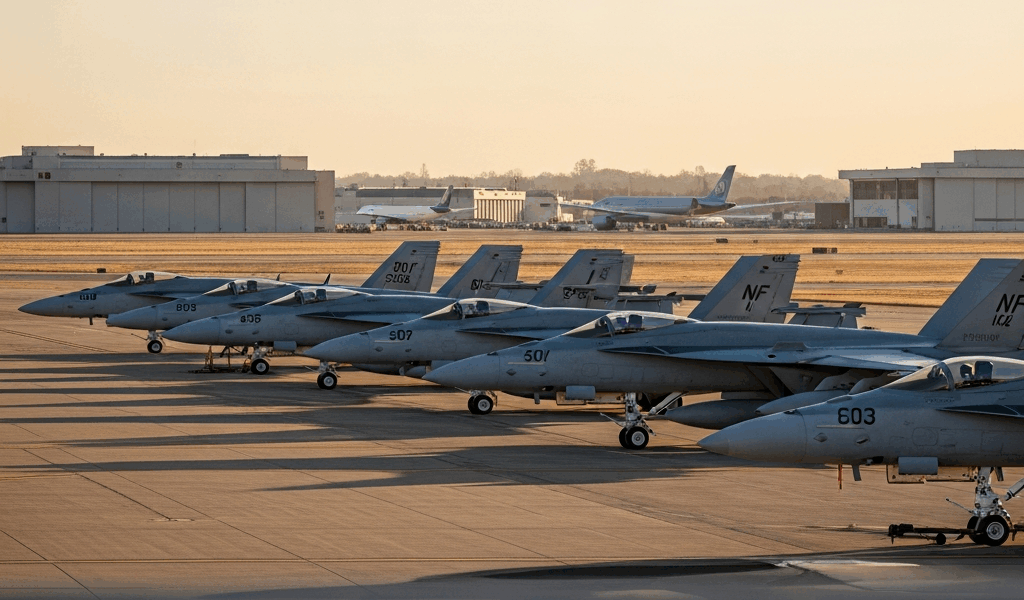
The Air Force and Navy maintain separate demo teams (the Thunderbirds fly F-16s for the Air Force; the Blue Angels fly F/A-18s for the Navy), and both operate under Congressional scrutiny. Military leadership has to justify every appearance. A show at a Navy installation in San Diego directly supports recruitment messaging to the local population. A show at a private airshow in suburban Ohio? That requires a different justification entirely, and it’s harder to make that case when budget discussions happen in Washington.
Probably should have opened with this section, honestly — liability is the second major factor. Commercial airshows carry inherent risks that military officials want to avoid owning. If a civilian airshow has a fatal accident (which has happened at various events), the proximity of military demo teams to that event creates potential legal entanglement. By restricting appearances to military-controlled venues, the Navy limits liability exposure. Military bases have standardized safety protocols, dedicated military law enforcement, and controlled airspace in a way that most civilian airshows simply don’t.
Then there’s operational control. At a Navy installation, the military dictates every parameter: crowd management, emergency procedures, runway configuration, noise restrictions, and safety distances. At a civilian airshow, organizers make those calls. The Navy’s position, essentially, is that they can’t guarantee safety standards at events they don’t control.
What Civilian Airshows Actually Get Military Jets
Here’s where it gets interesting for people who still want to see military jets perform. You can absolutely see military aircraft at civilian airshows — just not the Blue Angels, and typically not the Thunderbirds either, though they show up more frequently.
The Columbus Air Show in Columbus, Mississippi regularly features F-15 Eagle demo flights piloted by Air Force active-duty pilots. Not the organized Thunderbirds team, but skilled pilots nonetheless. Oshkosh EAA AirVenture, the largest airshow in North America, hosts various military assets and flyovers, but not official demo teams. The Abbotsford International Air Show in British Columbia gets Canadian military demonstrations but not U.S. demo teams. Daytona Beach’s airshow features military heritage flights and various military performers — again, not Blue Angels or Thunderbirds.
What you can see instead includes heritage flights (vintage military aircraft paired with modern jets), individual military pilots performing solo demonstrations, Air Force F-16 or F-22 flyovers, and Navy legacy aircraft displays. These are still incredible to watch. The difference is scale and official team branding.
I watched a solo F/A-18 Super Hornet demonstration at a civilian event a few years back, and it was genuinely stunning. The pilot performed inverted passes and high-G maneuvers that had the crowd on their feet. The performance quality was comparable to what the Blue Angels do. The real difference is that it wasn’t the official Navy aerobatic team, so it doesn’t carry that specific prestige or the synchronized formations.
How to Find Blue Angels Performances Near You
If you’re actually committed to seeing the Blue Angels perform, skip the general airshow circuit entirely.
The official Navy Blue Angels website (blueangels.navy.mil) publishes their complete annual schedule by November of the previous year. This is your primary resource. The schedule breaks down every performance date, location, and whether civilian attendance is permitted. Most performances happen at Naval Air Stations or Marine Corps Air Stations, but some Navy Week events in major cities include airshow components that welcome public attendance.
Navy Week events happen in different U.S. cities each year. Recent years have included San Francisco, New York, Boston, Chicago, and San Diego. The Blue Angels often perform during these weeks — they’re specifically designed as public outreach. You can see a list of Navy Week cities on Navy.com.
Follow the official Blue Angels social media accounts (@BlueAngelsNAVY on Instagram and Twitter). The team posts schedule updates, practice session announcements, and sometimes behind-the-scenes content. If you can find local Navy installations near you, check their events calendars — some host public air shows where the Blue Angels appear.
Pro tip: arrive early to these events. Very early. I’m apparently not a morning person and this has bitten me before — crowd management at Navy installations is real, and parking fills up fast. I’ve heard from people who arrived just two hours before a 2 p.m. start time and found parking lots completely full. Don’t make my mistake.
The Difference Between Blue Angels and Thunderbirds Schedules
You might notice that the U.S. Air Force Thunderbirds appear at more civilian airshows than the Blue Angels do. This is a real phenomenon, not your imagination.
The Thunderbirds perform around 100 shows per year, compared to the Blue Angels’ 70. More importantly, the Air Force has historically taken a slightly more flexible approach to civilian airshow participation. In any given year, you might see 3-5 official Thunderbirds performances at civilian airshows, whereas Blue Angels civilian airshow appearances are essentially zero.
This difference stems partly from different organizational philosophies and partly from logistics. The Air Force base structure gives the Thunderbirds more flexibility in scheduling. It’s not a hard rule, but it’s a clear trend when you look at historical schedules.
That said, if you can only choose between trying to find Thunderbirds at a civilian event versus waiting for Blue Angels at a Navy venue, the Blue Angels option is more reliable. You know exactly where and when they’ll perform. You don’t have to wonder if this particular airshow made the cut.


Stay in the loop
Get the latest airshow spectacle updates delivered to your inbox.