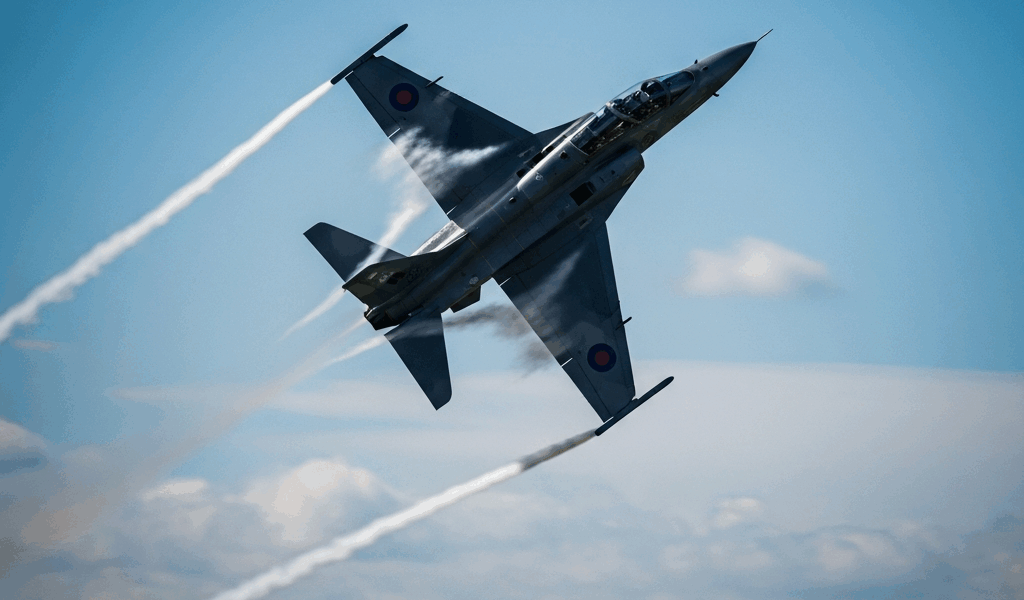
The only British company building a homegrown successor to the BAE Systems Hawk T1 has collapsed — taking with it the clearest path to keeping the Red Arrows in a British-built aircraft beyond 2030.
Aeralis entered administration on Friday, May 16, 2026, with the appointment of joint administrators David Buchler and Joanne Milner of Buchler Phillips announced the previous day, on 15 May. They were appointed to wind down the firm’s affairs, and approximately 30 employees lost their jobs. The company had been developing a modular jet trainer — designed entirely in digital form — intended to replace the Hawk T1 in RAF service, with the Red Arrows display role explicitly in scope.
Why It Collapsed
Administrators cited “continued delays to the UK Defence Investment Plan, combined with geopolitical factors affecting sources of funding” as the cause of sustained cashflow pressure. The official language is diplomatic. The reality is starker.
Qatar’s state-owned Barzan Holdings — which had increased its stake in Aeralis to 24.9% by the end of 2024 — pulled its credit commitments following geopolitical factors reported to include the economic fallout from the US-Iran conflict. Separately, negotiations to supply jets to the French government also fell through.
Aeralis founder and CEO Tristan Crawford conceived the project while working on the Hawk at QinetiQ, and built the company around a seven-firm British consortium called AERTEAM — including StandardAero, Thales UK, Martin-Baker, and Hamble Aerostructures. In September 2025, the company signed a final-assembly agreement with Glasgow Prestwick Airport. As recently as April 26, 2026 — just three weeks before the collapse — Aeralis was citing “clear and unequivocal demand from former Red Arrows pilots” for a British-designed successor.
“Aeralis has developed a highly differentiated proposition within the aerospace and defence sector. We hope that the administration process will provide an opportunity to explore routes to preserve and develop that value for stakeholders.” — Joanne Milner, Joint Administrator, Buchler Phillips
The Red Arrows Problem
The Red Arrows have flown the Hawk T1 since 1979 — over 40 years and nearly 5,000 public displays. The 16 aircraft based at RAF Waddington are aging hard. The youngest jet in the fleet is already 43 years old. Two T1s have logged more than 10,000 flight hours, leaving a shrinking margin before the 12,400-hour design maximum. The fleet is scheduled to retire in 2030.
The Ministry of Defence confirmed this week that “no final procurement decisions have been made” on a Hawk successor. Defence Minister Maria Eagle had previously told Parliament the replacement question was “under active consideration,” but the long-delayed Defence Investment Plan has repeatedly blocked any firm commitment.
“We really have everything here [in the UK]… it would be an absolute travesty if we didn’t exploit that supply chain to generate a new British aircraft.” — Tristan Crawford, Aeralis CEO
The Hawk’s legacy as a British export success was built partly on the Red Arrows using it as a global shop window — over 1,000 sold to 18 operators worldwide. With Aeralis gone, that argument no longer has a product behind it.
Who’s Left in the Frame
The remaining contenders are all foreign-designed. BAE Systems has partnered with Boeing and Saab to offer the T-7A Red Hawk, with a proposed British final-assembly line to soften the optics. Leonardo is promoting its M-346, already in front-line service with several air forces. Lockheed Martin displayed a TF-50 — its version of the Korean KAI T-50 — in Red Arrows colours at DSEI London last September.
RUSI Senior Research Fellow Justin Bronk has described the Aeralis option as “purely theoretical” and noted that the Leonardo and T-7A alternatives are “low-risk, high-quality” options realistically deliverable before 2030.
The RAF is now understood to be moving toward a two-batch procurement — a smaller first purchase to re-equip the Red Arrows ahead of the T1 retirement, followed by a larger order to replace the Hawk T2s at RAF Valley toward the end of the 2030s.
Meanwhile — The Red Arrows Head to America
The timing is acutely awkward. Wing Commander Sasha Nash is currently leading the Red Arrows through preparations for their first U.S. tour since 2019 — the team’s last North American appearance having been the 2024 “Maple Hawk” tour of Canada. This summer’s tour honours America’s 250th anniversary, with confirmed appearances including Fourth of July flyovers in Washington D.C. alongside the USAF F-22 Raptor Demonstration Team, and three afternoon displays at EAA AirVenture Oshkosh on July 24–26. The U.S. commitment means the team is not expected at the Royal International Air Tattoo at RAF Fairford on July 17–19.
“The tour will celebrate and underline the enduring relationship between the United Kingdom and our closest security partner… we’re excited and honoured to bring our signature display of red, white and blue to some of the biggest, most well-known airshows and events this summer.” — Wing Commander Sasha Nash, Officer Commanding, Red Arrows
The irony is difficult to miss: as Britain’s most iconic display team flies the Atlantic to showcase the nation’s aviation heritage, the last British company trying to build their next aircraft has gone under.



Stay in the loop
Get the latest airshow spectacle updates delivered to your inbox.