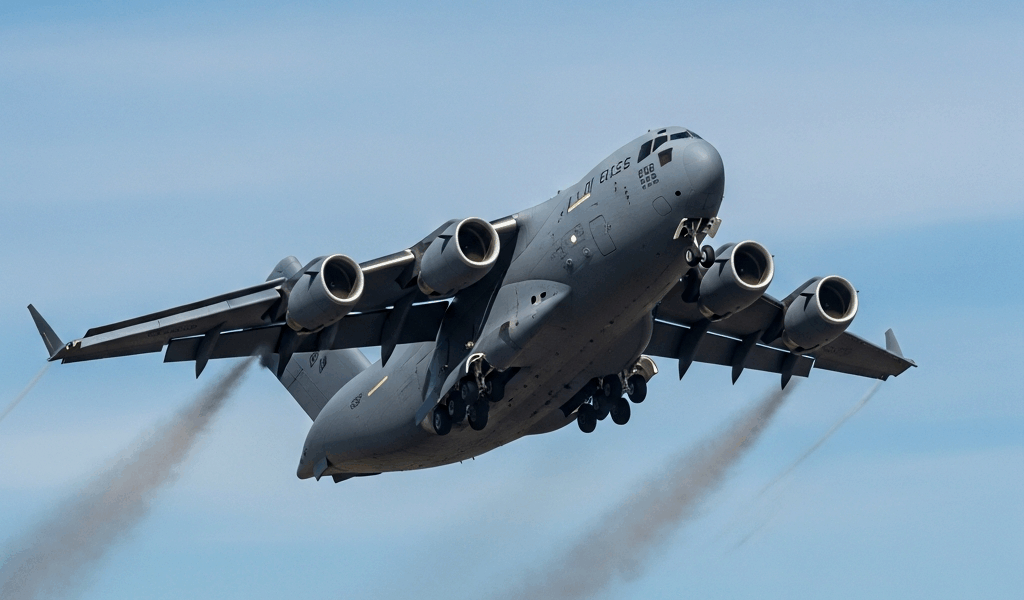
Why the C-17 Demo Is Worth Showing Up Early For
Military airshow coverage has gotten complicated with all the generic “top 10 lists” flying around.
But what is a C-17 Globemaster demo? In essence, it’s a 585,000-pound cargo aircraft performing maneuvers that have no business existing at that weight. But it’s much more than that. The cognitive dissonance hits you somewhere around the third second of a 60-degree bank turn — your brain keeps insisting something is wrong, because cargo haulers don’t move like fighter jets. Then your stomach flips anyway. Crowds gasp. Every time.
The short-field landing is where things get genuinely surreal. Pilots bring the aircraft in low and aggressive — nose pitched up at an angle that looks structurally inadvisable — then dump the throttles and deploy every drag device available. It settles onto the runway in roughly half the distance you’d expect from something with a 169-foot wingspan. If you’ve never heard a C-17 hit full reverse thrust from about 20 feet up, you’re missing one of the best audio moments aviation has to offer. Nothing prepares you for it.
There’s also the JATO myth worth mentioning. Solid rocket boosters supposedly strapped to the fuselage for short-field takeoffs. The Air Force stopped using JATO on C-17s years ago, but the legend refuses to die — and honestly, half the crowd is still watching for it. That curiosity alone keeps people pressed against the fence line, squinting hopefully.
It shouldn’t be graceful. It is anyway.
Airshows Confirmed or Expected to Feature the C-17 in 2025
Probably should have opened with this section, honestly. Most people scrolling this article want the list first and the context somewhere after. But without understanding what you’re actually watching, the list is just names and parking logistics.
One honest disclaimer before we go further: military demo schedules finalize close to event dates. I’ve learned the hard way not to stake travel plans on predictions made in January. What follows draws from historical patterns, Air Force Mobility Command communications, and confirmed appearances through late 2024. Verify with the show organizer. Always.
So, without further ado, let’s dive in.
- Joint Base Andrews Air and Space Expo (May, Maryland) — Consistent C-17 flying demo venue. Located near D.C. with major Air Mobility Command infrastructure already on site, it historically runs full 20-minute sequences — low passes, landing approaches, the works. This one earns the drive.
- Oshkosh AirVenture (July, Wisconsin) — Not annual, but frequent enough to watch for. When the C-17 shows up here, expect mostly static display with occasional low passes. Over 600,000 attendees means viewing angles are competitive. Arrive at gate opening — around 7:00 a.m. — if you want a useful spot.
- Luke Air Force Base Airshow (March, Arizona) — Historically featured full C-17 demos, though 2025 scheduling wasn’t fully locked as of late 2024. Luke’s proximity to Air Force flight test operations makes it a likely venue. Plan for a complete demo sequence if it’s confirmed.
- Scott Air Force Base Airshow (June, Illinois) — Scott is Air Mobility Command headquarters. The C-17 is practically a home team aircraft here, which means flying demonstrations show up more reliably than static displays. One of the stronger bets on this list.
- Barksdale Air Force Base Airshow (May, Louisiana) — Major mobility hub with a history of at least static C-17 displays, sometimes a limited demo. May timing helps — you’re not fighting heat shimmer or afternoon thunderstorms the way you would in August.
- Charleston Air Force Base Open House (April, South Carolina) — Active C-17 squadron home base. Static displays are essentially guaranteed. Flying demos depend on sortie availability and pilot scheduling. Call public affairs four weeks out to get a straight answer.
- Nellis Air Force Base Aviation Nation (November, Nevada) — Major event, strong Air Mobility Command participation historically. Full C-17 demonstrations have appeared here before. November heat shimmer is less brutal than summer, which helps viewing quality considerably.
- Hanscom Air Force Base Open House (May, Massachusetts) — Smaller venue than the others on this list, which actually works in your favor. Closer viewing distances, more manageable crowds. C-17 appearances aren’t frequent here, but when it does show, you’re not fighting 40,000 people for a fence spot.
Static Display vs. Flying Demo — What You Actually Get
Frustrated by watching a C-17 sit motionless on sun-baked tarmac after a four-hour round trip, I started researching the static-versus-demo distinction before committing to any airshow travel. Spent probably $600 in gas and entry fees before I figured out this was the question I should’ve been asking first. Don’t make my mistake.
A static display means the aircraft is parked on the ramp — crew nearby, questions answered, photo opportunities unlimited. The scale is genuinely striking up close. The tail stands 60 feet tall. People consistently underestimate that until they’re standing next to it. But there’s no engine noise, no demonstration of what the airframe can actually do, no moment that tightens your chest.
A flying demo is everything I described earlier. Low passes. Short-field landings. Bank turns that make the physics feel negotiable. These typically run 15 to 25 minutes and happen once or twice per show day — usually mid-afternoon when attendance peaks.
Bases with active Air Mobility Command squadrons — Scott, Charleston, Joint Base Andrews — lean toward flying demos. The infrastructure and pilots are already there. Civilian shows like Oshkosh trend toward static displays because scheduling military demo flights requires significant coordination and meaningful fuel burns. Some venues manage both: a morning static walk-through and an afternoon flying slot.
I’m apparently someone who calls public affairs offices directly, and that approach works for me while website-checking never actually does. Show websites update sporadically at best. A two-minute phone call two weeks before the event gets you current information. That’s the move.
Tips for Watching the C-17 Demo at Any Show
Position yourself on the north side of the runway when possible. Demo flights approach from consistent directions based on wind and traffic patterns — north-side spots typically offer better light angles and thinner crowds than the south grandstands. Ask show staff which direction demo approaches come from. They know, and they’ll tell you.
Bring binoculars. Something in the 8×42 range works well — I use Vortex Viper HD bins that run about $300 retail, but honestly, a $45 pair from a sporting goods store still beats squinting. You want to watch landing gear lower, catch control surface movements, see the thrust reverser doors deploy. Details that justify the trip.
Listen for the throttle cut. The C-17’s audio signature going from full power to near-idle is abrupt and distinctive — it happens right before the short-field landing sequence. That sudden near-silence is your cue to focus on the approach. It’s counterintuitively more attention-grabbing than the noise.
Arrive early. Not slightly early — two hours before gates open at a major show. The fence line fills faster than you’d expect, and standing behind someone’s 7-foot beach umbrella for a 20-minute demo is a specific kind of misery.
Put the phone down for the actual maneuvers. Record a clip if you want it. But watch the demo with your eyes. The turns happen faster than any camera setup anticipates, and you’ll spend the best 90 seconds of the show trying to reframe a shot instead of watching something genuinely impressive happen.
How to Find Updated C-17 Appearances as Shows Confirm Performers
Start with the official Air Mobility Command website and their social channels — Facebook and Instagram both get announcements. Demo schedules typically finalize and post six to eight weeks before each show date.
Individual airshow websites are your second source. Check their “Performers” or “Schedule” pages, but don’t trust information that looks more than a few weeks old. Call the public affairs office directly if the page seems stale. A two-minute conversation beats an hour of refreshing a webpage that last updated in November.
The Military Airshows aggregator page covers many base open houses and defense events in one place. Not comprehensive, but useful for mapping out a full season without visiting 30 individual websites.
Set reminders to check back in March, May, and June. 2025 schedules solidify on a rolling basis — what’s unconfirmed in January is often locked by April. I’ll be tracking confirmed appearances here as they’re announced.
One last thing worth saying plainly: military aircraft schedules shift. A C-17 confirmed for a June show might get pulled for actual airlift tasking two weeks out. It’s frustrating when it happens. It’s also the reason military airshows carry weight that civilian shows sometimes don’t — you’re watching real operational aircraft, not restored warbirds or purpose-built display planes. The readiness requirements that occasionally cancel an appearance are the same ones that make the appearance meaningful when it happens.




Stay in the loop
Get the latest airshow spectacle updates delivered to your inbox.