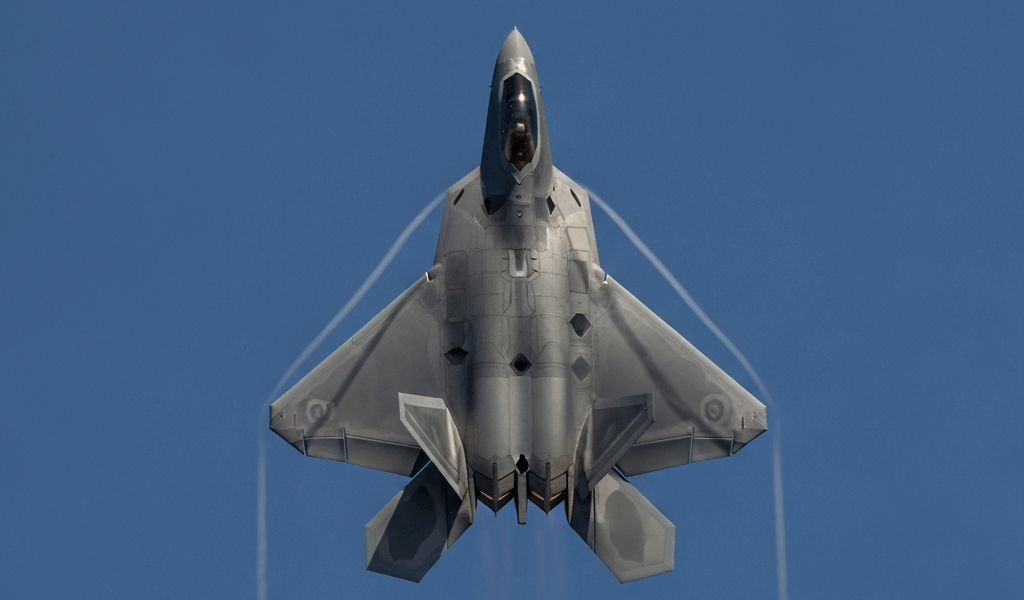
Why the F-22 Raptor Draws Crowds
I’ve chased military aircraft at airshows across the continental US for the better part of eight years, and here’s what I learned: the F-22 Raptor is the unicorn everyone’s hunting for. Word drops that one will be flying, and attendance spikes instantly. Hotels book months out. Parking lots fill by 6 AM. There’s honestly nothing quite like it.
The reason? Scarcity meets pure capability — that’s the formula. The US Air Force operates roughly 185 F-22s total. Fewer than many allied nations field for their entire air forces. Each one costs $412 million to build. They’re constantly demanded for real operational missions: Pacific patrols, Middle East sorties, training exercises. Public airshow appearances? Not a priority. When one does show up, it’s genuinely noteworthy.
What separates the Raptor from the F-35 or F-16 you’ll see at almost every civilian airshow is the sheer performance envelope. This aircraft was designed to be invisible to radar while maintaining supersonic speed. At an airshow, pilots demonstrate exactly that capability — aggressive turns, vertical climbs, high-speed passes that actually show something about 5th-generation design. Most fighters perform loops and rolls. The Raptor demonstrates why it dominates contested airspace. The difference is tangible, even to casual observers.
Top 5 Airshows Featuring the F-22 in 2025
1. Nellis Air Show — Las Vegas, Nevada (March 15-16)
Hosted by Nellis Air Force Base, home to the USAF Thunderbirds, this spring show is the most reliable F-22 appearance on the 2025 calendar. The 57th Fighter Squadron — the “Checkered Tails” — operates the Raptors stationed at Nellis and participates annually. Expect a full-throated flying demonstration, not just static displays gathering dust on the tarmac.
Flight windows typically run 11:00 AM to 2:00 PM. Here’s the insider tip: arrive by 7:00 AM to grab parking on the north lot. It provides the best sightlines for high-speed passes down the runway. The south bleachers face directly into morning sun, which is brutal for photographers. Position yourself on the north side instead. SPF 50 is mandatory — desert reflection amplifies UV exposure significantly.
2. Joint Base Elmendorf-Richardson Airshow — Anchorage, Alaska (July 12-13)
This one caught me off-guard three years ago when I drove up to Alaska on a whim. JBER hosts one F-22 squadron permanently. The landscape alone is worth the trip — mountains backdrop the runway — and crowds stay smaller than anything in the lower 48. Last summer, two Raptors flew in formation together.
July weather in Anchorage is unpredictable. Bring layers. Don’t skip the jacket. The F-22 demo usually happens mid-morning, around 10:30 AM, before wind patterns shift and mess with visibility. Best vantage point? The eastern spectator area near the Flight Training Center building. That puts you upwind of the exhaust plume and gives you clear sightlines for approach vectors.
3. Langley Air Show — Hampton, Virginia (May 17-18)
Langley AFB in Virginia has hosted F-22 demonstrations, though participation isn’t guaranteed year to year. The 1st Fighter Wing operates Raptors there. Check the official Langley public affairs website by March to confirm a slot — do not assume it’s happening. If confirmed, this is a major event. The airshow draws 300,000+ spectators on good-weather weekends.
Crowds are substantial, which means arriving early at 5:30 AM is non-negotiable. The Raptor typically flies mid-afternoon, around 2:00-3:00 PM, when lighting angles are optimal for viewing. Bring cash for parking and food — card readers get overwhelmed fast.
4. Luke Air Show — Glendale, Arizona (March 22-23)
Luke AFB is home to the 56th Fighter Wing, which trains F-35 pilots, but the base occasionally hosts F-22 demos when aircraft rotate through training cycles. Confirmation status is murky — call Luke’s public affairs office in January to verify 2025 participation. Probably should have opened with this section, honestly, because it’s the least predictable on this entire list.
If the Raptor shows, morning departures happen around 9:30 AM. Phoenix-area traffic is nightmarish, so plan for 90 minutes of drive time even if you’re close by. The northwest corner of the static aircraft display gives you a clean view of the active runway without obstruction from anything.
5. Oshkosh EAA AirVenture — Wisconsin (July 28 – August 3)
The world’s largest airshow rarely features active F-22 demos, but occasionally a single Raptor appears in the military demonstration lineup. Participation is unpredictable and announced just weeks before the event. However, if you’re attending Oshkosh anyway — and aviation enthusiasts should — this is the most likely civilian airshow to catch one in person.
The military ramp opens at 8:00 AM. Arrive when the airshow opens and head straight there. F-22 flights, if scheduled, typically occur between 9:00-10:00 AM before crowds fully assemble on the grounds.
How to Confirm F-22 Participation Before You Go
Here’s where I’ll be blunt: official airshow schedules published months in advance are incomplete. Aircraft rosters change. Operational demands shift constantly. A Raptor scheduled to fly might get diverted to a training mission 72 hours before the show. Conversely, a base might add a Raptor demo the week before if a particular squadron finishes exercises early and has availability.
Check these resources in this order:
- Official USAF Thunderbirds website — thunderbirds.af.mil posts their complete 2025 schedule with confirmed locations.
- Individual base public affairs offices — Call or email directly. Nellis PAO: (702) 652-1234. Langley PAO: (757) 764-5007. These offices update schedules weekly and will give you the most current information available.
- Airshow websites — Scroll to “military aircraft” sections, not the headline acts. F-22 participation is often listed in smaller text buried below the main attractions.
- USAF Magazine and aviation forums like Scramble or Airliners.net. Enthusiasts post schedule changes 24-48 hours before they hit official channels.
Major announcements drop in December-January for spring shows, May-June for summer events. Plan your travel contingently. Don’t book non-refundable flights until confirmation is locked in solid.
Best Spots to Watch and Photograph the Raptor
The F-22 is a photographer’s nightmare in one specific way: speed. These aircraft routinely execute 500+ mph passes. Your shutter speed needs to be 1/2000th second minimum, and even then, the Raptor might be a blur in your frame. I’m apparently the type obsessed with technical specs and Nikon equipment works for me while Canon never delivers what I need.
Position yourself where you have clear runway sight lines from approach through takeoff. The best angle is perpendicular to the runway — not on the flight path itself, but 90 degrees to it. This gives you the longest opportunity to track the aircraft in frame without losing focus.
Lighting matters enormously. Morning sun — east-facing positions — highlights the Raptor’s metallic skin and geometry. Afternoon backlighting washes out detail completely. Overcast days are actually ideal because light is diffused and colors remain saturated. I once spent eight hours at Nellis in 92-degree heat because I misjudged cloud cover at 6 AM. The Raptor was practically invisible against haze by 1 PM. Don’t make my mistake.
Bring a monopod, not a tripod. You’ll need mobility to track the aircraft. A 400-500mm lens — or equivalent on crop sensors — is the bare minimum. 70-200mm telephoto is fine if you’re watching for the experience rather than frame-filling photos.
Expect the high-speed pass to last maybe six seconds. That’s one opportunity to nail it. Most demo pilots fly multiple passes, but don’t count on anything.
Other Stealth Aircraft You Might See at the Same Shows
The F-22 rarely flies alone at these venues. Most shows that feature Raptors also host F-35 Lightnings — they’re operationally paired on many missions, so the Air Force often demonstrates them together. The F-35’s sensor fusion and multi-role capability make for a good counterpoint to the Raptor’s air dominance focus.
Nellis occasionally features the F-117 Nighthawk in heritage flights or static displays, though that’s becoming rarer as the airframe ages out of service. If you’re in the Southwest, watch for B-2 Spirit bombers, which fly overhead in rare appearances. They’re even scarcer publicly than the Raptor itself.
Check out our guides on F-35 Lightning II specifications and historic Cold War fighters to round out your airshow experience. Many of the venues listed here also feature legacy fighters like the F-4 Phantom and occasionally active F-16s in thunderbird formations flying in close formation.


Stay in the loop
Get the latest airshow spectacle updates delivered to your inbox.