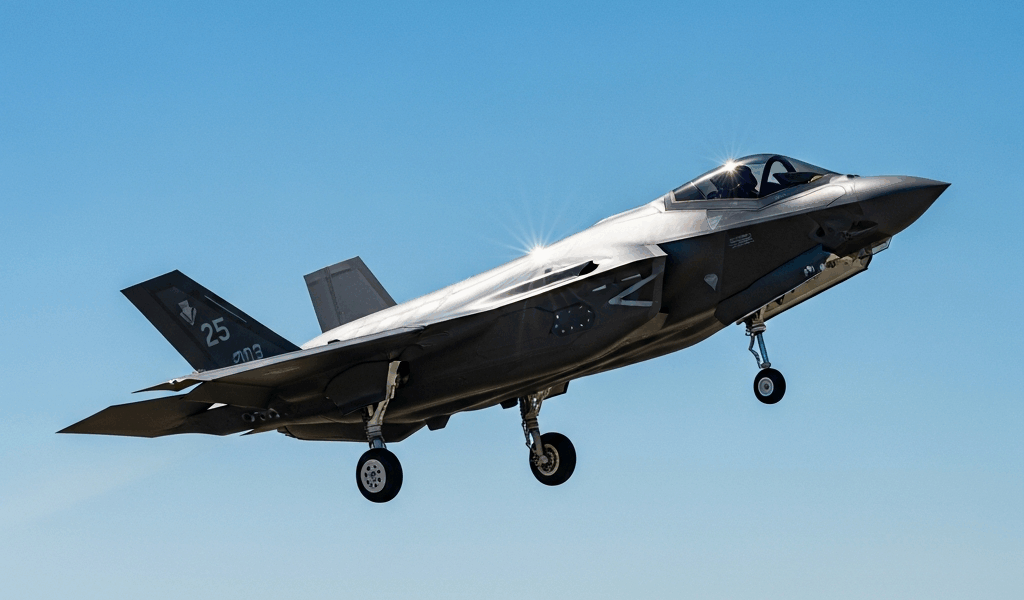
Why the F-35 Draws Crowds (Even Before It Flies)
I’ve spent the last five airshows chasing F-35 demos, and I still get that same rush watching it take the runway. The Lockheed Martin F-35 Lightning II has gotten complicated with all the budget controversy flying around—which is exactly why spectators can’t look away. It’s the most polarizing aircraft in the sky.
At $115 million per unit, the F-35 represents the most expensive military program in history. Adopted by the U.S., Canada, Australia, Japan, South Korea, and Poland, it’s everywhere and nowhere at once. That global footprint means it’s simultaneously a symbol of Western air superiority and a lightning rod for budget criticism. People show up wanting to see if this controversial machine actually performs, and that skepticism makes the crowds lean in harder.
But what makes it so magnetic? In essence, it’s the aircraft’s angular, almost alien silhouette—it looks fast even parked. The single engine produces a distinctive high-pitched whine that converts casual airshow attendees into F-35 devotees within seconds of the first flyby. Probably should have opened with this section, honestly. The sound alone does the work.
Top 3 Airshows Featuring F-35 Demos in 2025
1. Nellis Air Force Base Aerospace Expo — Las Vegas, Nevada (March 22–23)
Nellis hosts the U.S. Air Force’s primary F-35A Lightning II training squadron, the 57th Fighter Squadron, and they field demonstration pilots year-round. This is your most reliable venue for guaranteed F-35 solo performances. The 2025 expo runs two days and draws 400,000+ spectators.
The 57th Fighter Squadron usually runs 10-minute profiles featuring high-G turns, vertical climbs, and controlled slow passes — at least if you want to see the aircraft’s VTOL-adjacent capabilities and sustained turn rates. The show uses the full 14,000-foot Nellis runway, so the demo corridor extends far downrange.
Best viewing spots? The north ramp area near the static display parking gives you head-on approaches. Bring binoculars — serious ones. A pair like the Vortex Optics Diamondback HD 8×42 (around $400) makes the difference between seeing actual cockpit detail and just knowing a jet passed overhead. The south spectator areas work for side profiles if you’re patient enough to wait.
Logistics: Nellis is 12 miles northeast of Las Vegas. Parking fills by 7 a.m. on show days, so gate opening at 8 a.m. means you should arrive by 6:30 a.m. for reasonable lot placement. Admission runs $20 adults, $10 military and seniors. No outside coolers permitted, but the concession food—while expensive at $14 for a sandwich—is honestly better than most military base offerings.
2. Oshkosh EAA AirVenture — Oshkosh, Wisconsin (July 28–August 3)
EAA AirVenture is the world’s largest air show, and the F-35 has appeared here four of the last six years. The 2025 iteration will likely feature an F-35A from an active-duty demo team, though specific pilot assignments don’t release until early summer.
The demo area is enormous — the aircraft have a massive operating envelope to work with. F-35 demos here tend to stretch 12–15 minutes and include formation passes with legacy fighters like the F-16 or F-15E. Those comparative passes are gold for spectators. You finally understand the F-35’s modern flight envelope when you see it banking tighter than a fourth-gen fighter without any apparent wing rock.
Best viewing spots: The north side of the runway, especially the “Ultralight Flyer” parking areas, gives clean sun angles in the morning. Afternoon demos favor the south spectator seating. Bring a folding chair and stake ground early — Oshkosh gets crowded by 10 a.m.
Logistics: Wittman Regional Airport sits within the town. Parking uses a lottery system ($20 car, $5 motorcycle). If you don’t secure a lot, expect to shuttle from offsite parking areas 2–3 miles away. Seven-day passes run $75. The week-long commitment makes this a genuine pilgrimage for serious enthusiasts, and honestly, you should plan to stay 3+ days to catch multiple demo flights across different weather conditions.
3. Joint Base San Diego Miramar Air Show — San Diego, California (September 27–28)
Miramar hosts the U.S. Marine Corps’ VMX-1 Integrated Trainer Squadron, which operates F-35B variants with vertical landing capability. This is your only opportunity to see STOVL (Short Take-Off and Vertical Landing) F-35 demonstrations at a major American airshow.
The F-35B demo is visually distinct. You’ll see the hover pit maneuver — the aircraft essentially hovers and pivots on its vertical thrust. It’s 45 seconds of pure physics that no other multirole fighter can replicate. The demo is shorter than fixed-wing F-35A performances (7–10 minutes), but the vertical-landing portion is unmissable.
Best viewing spots: The east ramp near the static parking provides the clearest views of the hover pit. The south runway berm works for takeoff and transition passes. Weather impacts this show more than Nellis or Oshkosh — marine layer can delay demos until afternoon.
Logistics: Miramar is 12 miles north of downtown San Diego. Free admission and parking. Gates open at 9 a.m., so arrive by 8 a.m. if you want parking within walking distance. The base uses a military-style gate procedure — valid ID required (REAL ID compliant). First-time visitors should allow 45 minutes for the security screening.
How to Spot the F-35 and What to Expect
Hunched by its sleek canopy and cranked delta-wing geometry, the F-35 has an unmistakable silhouette. You’ll recognize it instantly at distance.
The engine sound is your early warning system. A single Pratt & Whitney F135 produces a distinctive high-frequency whine — nothing like the low rumble of a twin-engine fighter or the raw roar of legacy turbojets. Once you hear it twice, you’ll identify it instantly. The noise floor is surprising; it’s noticeably quieter than an F-18 Super Hornet at equivalent power settings.
Typical demo runs last 8–15 minutes depending on the airshow’s flight time allocation. Expect vertical climbs (the aircraft can sustain 7-G turns), controlled barrel rolls, high-speed passes at 350+ knots, and a slow-speed pass where the nose pitches down hard to demonstrate control authority at low airspeeds. The F-35A demo almost always includes a slow approach pass where the landing gear extends — you’ll actually see the dramatic asymmetrical gear geometry.
What’s different from F-16s and F-15s? The F-35 doesn’t have the same knife-edge ability in knife-edge rolls because of its configuration, but it compensates with sustained turn capability. The modern avionics mean the pilot can execute precision maneuvers that older fighters can’t match. You won’t see the snappy rolls that older Vipers do. Instead, you’ll see deliberate, controlled geometry changes. That looks less “hot-rod” and more “advanced,” which actually highlights the F-35’s real advantage.
Secondary Shows With Possible F-35 Static Displays
Dyess Air Force Base Open House — Abilene, Texas (typically May)
Dyess operates the 8th Fighter Squadron with F-35As. They don’t always commit to a full demo, but static displays are nearly guaranteed. Static-only airshows are underrated — you can walk around the aircraft, photograph the internal weapon bays, and actually see the design details that photos don’t capture.
Luke Air Force Base Luke Days — Glendale, Arizona (typically March)
Luke is home to the largest F-35A pilot training program. Multiple F-35s typically appear in static form. Demo participation depends on training schedules, so verify attendance within two weeks of the event.
These secondary venues have smaller crowds and longer viewing windows. Static displays let you see the F-35’s actual scale — it’s smaller than you expect, roughly comparable to an F-16 in footprint but with a wider fuselage.
F-35 Appearance Trends and What to Plan For
Schedule volatility is real. I’ve learned this the hard way. The F-35 program undergoes continuous maintenance cycles and software updates. Demonstration pilots occasionally get reassigned during the season.
Weather impacts F-35 demos more than legacy fighters. The aircraft’s advanced systems have strict operating parameters — ceiling below 3,000 feet usually cancels demonstrations. Wind gusts above 25 knots can push the demo to the next day. I attended Nellis in 2023 expecting an F-35 demo and got a cancellation notice at 10 a.m. due to crosswind gusts. The organizers never rescheduled that slot.
Maintenance emergencies happen. Engine issues or hydraulic concerns can pull demonstration aircraft from the schedule with minimal notice. Verify F-35 participation within 72 hours of the show date. Most major airshows now post demo confirmations on their websites Thursday evening for weekend shows.
Pro tip: Follow the Air Force Materiel Command’s official schedule and cross-reference with the specific airshow’s announcement page. Don’t rely on preliminary show programs published six months out — those are educated guesses, not confirmations. Your best guarantee is calling the base public affairs office directly. They’ll tell you honestly whether the F-35 is confirmed.
Bring a camera with zoom capability — even a smartphone with 10x optical zoom (like the Samsung S24 Ultra) captures usable detail. Bring sunscreen, a hat, and water. Airshows are 6–8 hour events in direct sun, and dehydration clouds your memory of what you actually saw. Most importantly, just go. The F-35 is the future of air combat, and watching it demonstrate why, in person, is genuinely worth the travel.

Stay in the loop
Get the latest airshow spectacle updates delivered to your inbox.