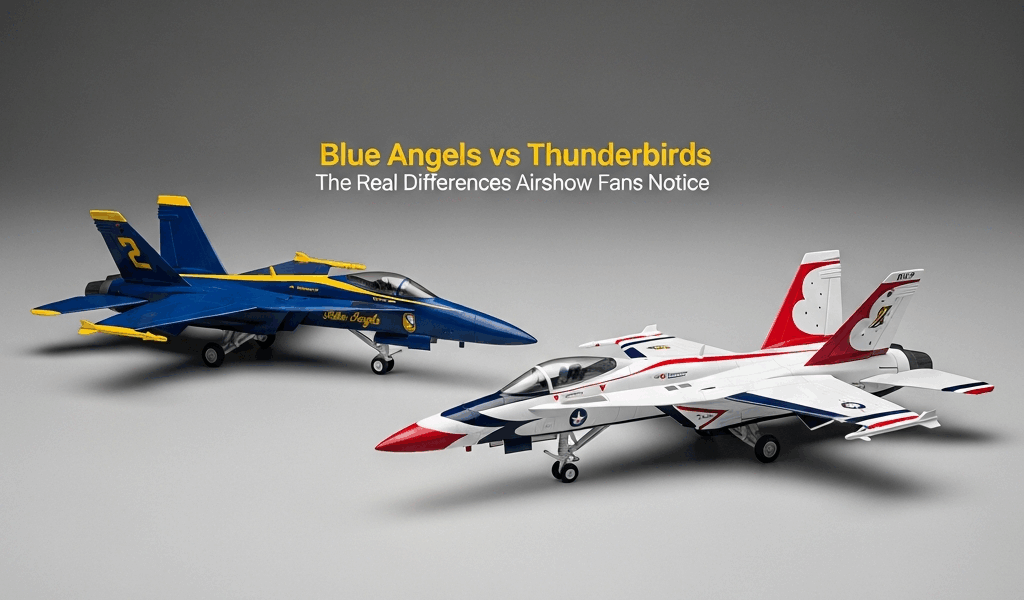
Blue Angels vs Thunderbirds — The Real Differences Airshow Fans Notice
The Blue Angels vs Thunderbirds debate has gotten complicated with all the hot takes and service-branch loyalty flying around. I’ve stood on enough flight lines — from the packed spectator rail at NAS Pensacola to the sprawling lakefront crowd at the Chicago Air and Water Show — to tell you the differences run much deeper than Navy versus Air Force. The aircraft are different. The philosophy behind each show is different. Even the way a crowd reacts is different. So if you’re trying to figure out which show deserves your Saturday, or just want to know what you’re actually watching when both teams land on the same schedule, here’s what matters.
The Quick Take — Precision vs Power
Ten seconds to explain it? The Blue Angels make you nervous. The Thunderbirds make you flinch. That’s the most honest summary I can hand you after years of standing on hot tarmac squinting into a white sky.
The Blue Angels are built around tension. Slow-burn, creeping disbelief — six aircraft holding formation so tight you keep waiting for the moment it all falls apart. It never does. That’s the product. The crowd goes quiet in a way that doesn’t happen at most airshows. People stop mid-sentence. Kids forget they wanted a corn dog thirty seconds ago. There’s a collective breath-holding that stretches for whole minutes at a time.
The Thunderbirds hit differently. Their show is kinetic — high-speed passes, aggressive climb angles, opposing solos crossing the crowd box with a sonic crack that physically moves your shirt. Where the Blue Angels give you precision, the Thunderbirds give you shock. Neither approach is wrong. They’re just optimized for completely different emotional outcomes.
The Blues want sustained awe. The Thunderbirds want you to jump out of your shoes and laugh about it afterward.
This article includes affiliate links. We may earn a commission at no extra cost to you.
The Aircraft — F/A-18 Super Hornet vs F-16 Fighting Falcon
Probably should have opened with this section, honestly. The aircraft explain almost everything about why these two shows feel so different the moment the engines light.
The Blue Angels — Boeing F/A-18 Super Hornet
But what is the Super Hornet in this context? In essence, it’s a large, twin-engine carrier-based strike fighter. But it’s much more than that when six of them hold a diamond formation at 400 knots and fly past you close enough to feel the wake turbulence in your jacket.
The Blues currently fly the Boeing F/A-18 Super Hornet — single-seat F/A-18E variants for most of the team, with a two-seat F/A-18F assigned to the Number 7 aircraft used for media and VIP flights. Wingspan of 44.9 feet. Maximum takeoff weight pushing 66,000 pounds. That size is part of the show. The visual mass of six of them in tight formation is genuinely overwhelming in a way photos don’t capture.
At slow speed — which the Blues lean on heavily during close-formation sequences — the Super Hornet produces a low, grinding roar you feel in your sternum. The GE F414 engines put out around 22,000 pounds of thrust each in afterburner, but it’s the heavy, resonant quality of the sound at demonstration speeds that gets people. Don’t make my mistake — I stood directly under their show line at Pensacola without ear protection for the first few passes once. Learned that lesson standing in a parking lot afterward, ears ringing, eating a lukewarm hot dog and reconsidering my choices.
The aircraft also fly stripped of several operational systems. Fuel dump equipment gets replaced with smoke oil tanks. The lead solo can demonstrate high angles of attack that show off the Super Hornet’s aerodynamic envelope in ways you’d rarely see from a fleet aircraft publicly.
The Thunderbirds — Lockheed Martin F-16C Fighting Falcon
Frustrated by the weight and bulk of earlier demonstration aircraft, early Air Force show planners eventually settled on the F-16 — and the choice makes sense the second you watch one light the afterburner on takeoff. The Thunderbirds fly the F-16C Block 52, powered by a Pratt & Whitney F100-PW-229 producing around 29,160 pounds of thrust in full afterburner. In a jet weighing significantly less than the Super Hornet, that thrust-to-weight ratio means speed. Real speed. The kind that makes the aircraft look like it skips a few rules of physics.
The cost gap between these jets is worth knowing — not because it changes the show, but because it puts both programs in context. The F/A-18 Super Hornet runs roughly $67–70 million per aircraft. The F-16C sits closer to $14.5 million. That doesn’t mean the Thunderbirds get less support — both teams are meticulously funded and maintained. What it means is the F-16 was designed around light, fast, and aggressive. Every choice the Thunderbirds’ show coordinators make flows from that basic character.
At high speed, the F-16 screams. No other word for it. The high-pitched turbine whine on a close-in, supersonic-adjacent pass is a completely different audio experience than the low thunder of the Super Hornet. First-timers at Thunderbird shows are often more startled by the sound than by anything they actually see.
The Show — What Each Team Does Differently
Blue Angels — The Formation Work
The Blue Angels’ signature is the diamond — positions 1 through 4, flying with wingtip-to-wingtip clearance officially stated at 18 inches during certain maneuvers. Watching that diamond bank and roll while maintaining that spacing is the visual centerpiece. Pilots are pulling up to 7g through some of these sequences, flying without the automated safety systems operational pilots depend on, managing formation entirely through radio calls and years of practiced timing.
The two solos — positions 5 and 6 — build speed while the diamond works, then cross in front of the crowd at angles that make the geometry look wrong. The opposition pass, where both solos head directly at each other with a combined closure rate over 1,000 mph and cross at show center, stops the crowd every single time. Every time. I’ve watched it probably a dozen times across different venues and it still lands like it’s new.
The show builds slowly and deliberately. Quieter moments between sequences. By the time the finale arrives — the full six-plane delta with tight spacing, then the break — the crowd has been wound up for close to an hour and doesn’t quite realize it.
Thunderbirds — High-Energy Passes and Shock Maneuvers
The Thunderbirds run a show built on constant forward momentum rather than slow-burn tension. The diamond delta formation performs maneuvers like the opposing knife-edge pass — two aircraft converging inverted and upright simultaneously — designed for maximum visual impact at distance. Their solo work hits harder in terms of raw speed. The high-speed, low-altitude pass by the lead solo is one of the faster things you’ll witness at any domestic airshow.
The energy footprint is wider, too. More sky used, more altitude variation, more moments where the aircraft are far from the crowd box but still pulling aggressive maneuvers you can track across a long distance. Segments flow quickly — less dead air between sequences. For families with kids too young to hold attention through subtle precision work, the Thunderbirds’ pacing genuinely works better. That’s not a criticism. It’s an honest observation about who each show structure is built to serve.
Signature maneuvers worth knowing: the Sneak Pass, where a solo approaches from behind the crowd at low altitude and high speed — apparently this is the one that makes people actually scream, and I can confirm that’s accurate — the Delta Break, all six aircraft simultaneously breaking from formation in different directions, and the Calypso Pass, one aircraft inverted close to the ground while another passes above it upright. These land on a first-time crowd the same way they land on veterans. That’s the engineering behind the show.
The Selection Process — How Pilots Join
Both teams pull from active-duty military aviators. Both processes are competitive enough that most candidates wash out. Airshow fans ask about this constantly, so the details are worth laying out.
Blue Angels Selection
The Blue Angels accept applications from active-duty Navy and Marine Corps tactical jet pilots. Minimum requirement is 1,250 flight hours in tactical aircraft — in practice, most candidates who actually get selected have considerably more than that. The selection process involves flying with the current team at NAS Pensacola, their home base in the Florida panhandle. Then the existing team members vote on new candidates. That peer-vote structure is unusual in military selection pipelines and reflects how much the team depends on interpersonal trust — you’re flying 18 inches from these people for two years.
Officers serve two-year assignments, flying roughly 140 shows over that period. After leaving, most return to fleet assignments carrying a reputation that follows them. Some go to test pilot programs. A handful eventually end up at the airlines. These are not career airshow pilots — they rotate back into operational roles, and the Blues tour is a chapter, not the whole story.
Thunderbirds Selection
The Thunderbirds draw exclusively from active-duty Air Force pilots, requiring approximately 1,000 hours in high-performance jets. The formal application and interview process runs through Nellis Air Force Base in Nevada — home turf for the team. Finalists fly with the team, similar in structure to the Blue Angels process.
Tours run two years for most positions, with the commander and opposing solo sometimes extending. Post-assignment paths mirror the Blues — fleet roles, test pilot programs, career advancement that the tour legitimately supports. Apparently, having “Thunderbirds demonstration pilot” on a promotion board file carries weight. Makes sense when you think about what the job actually involves.
One thing that surprises people: neither team maintains a formal waiting list. Pilots apply when openings are announced, and selection cycles run annually. The winter training period — Blue Angels at NAF El Centro in California from January through March, Thunderbirds doing their work at Nellis — is where new members either get there or don’t. Both training seasons are notoriously demanding and quietly produce a fair amount of attrition before the public show season ever begins.
Which Show Should You See First?
The answers cluster in a way that’s genuinely useful.
See the Blue Angels first if you want a show that rewards attention. If you’re the kind of person who tracks wingtip spacing through a bank, who’ll stay for the post-show Q&A to catch the debrief radio calls, who notices the moment the formation adjusts a half-foot and wonders what caused it — the Blues will give you more to think about. Their show asks something of the audience. The payoff is high. You have to meet it halfway.
See the Thunderbirds first if you’re new to airshows, bringing kids under ten, or want an event that delivers impact without requiring any prior knowledge to appreciate. The Sneak Pass alone will convert anyone. I have personally watched people who opened the day by saying they “don’t really care about planes” completely lose their composure at that maneuver. No context required. The show is engineered for exactly that reaction.
The honest answer — and These aren’t competing products. They’re two different philosophies about what military flight demonstration should accomplish. One is rooted in sustained, almost meditative precision. The other is built for immediate, visceral impact. The best version of this debate is seeing both in the same season, at different venues, and noticing how differently you feel walking off the flight line each time.
Practical recommendation: if you’re in the southeastern United States, the Blue Angels Homecoming Airshow at NAS Pensacola is the right context to see them. Home field, crowd that knows the show, energy that you won’t replicate at a neutral venue. For the Thunderbirds, the Academy Airshow at the Air Force Academy in Colorado Springs gives you a venue and an audience that amplifies everything they do — the altitude, the backdrop, the crowd composition. Both are worth the drive.
Gear-wise, a pair of Nikon Monarch M5 8×42 binoculars lets you track the tight Blue Angels diamond formation at altitude, and a Canon EOS R50 mirrorless camera captures the Thunderbirds’ high-speed passes without the bulk of a full DSLR rig. Pick one for next season. Pick the other for the season after. You’ll understand exactly why people argue about this at every flight line in America — and you’ll probably pick a side. But you’ll respect both.

Stay in the loop
Get the latest airshow spectacle updates delivered to your inbox.