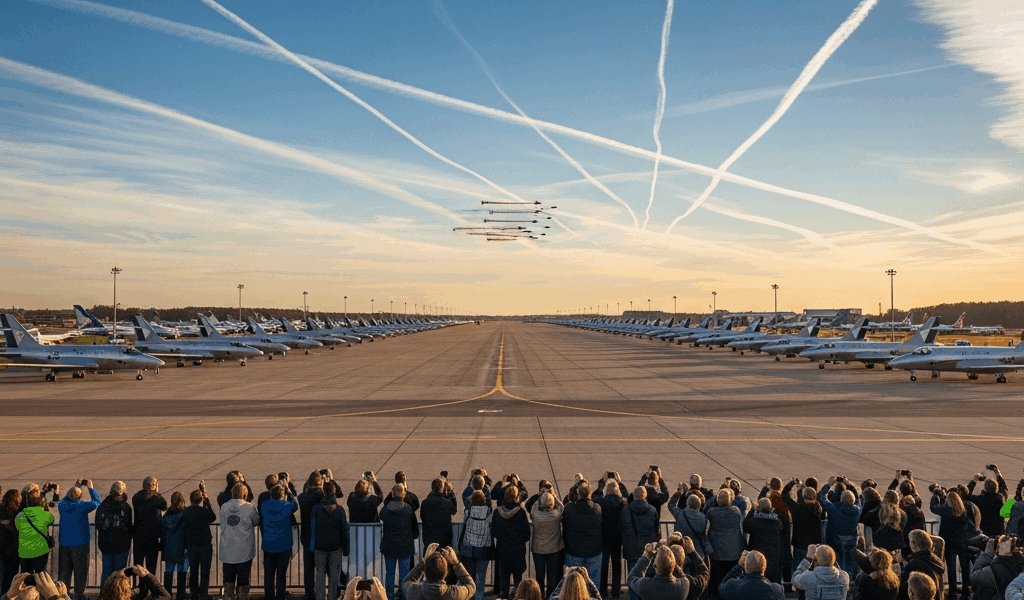
How We Define Biggest — Attendance, Spectacle, or Both
Airshow rankings have gotten complicated with all the conflicting lists and half-baked opinions flying around. As someone who has walked flight lines on three continents and stood in crowds ranging from 50,000 to well over half a million people, I learned everything there is to know about what separates a truly massive airshow from one that just feels big. Today, I will share it all with you.
This article includes affiliate links. We may earn a commission at no extra cost to you.
But what is the “biggest airshow in the world”? In essence, it’s whichever event scores highest across attendance, performer quality, aircraft variety, and cultural standing inside the aviation community. But it’s much more than that. EAA AirVenture Oshkosh crushes everyone on raw arrivals — 600,000+ in peak years. The Royal International Air Tattoo owns international scale. MAKS Moscow commanded serious respect before geopolitics scrambled the schedule. Paris Air Show plays a double identity: trade event and public spectacle simultaneously. And Miramar delivers concentrated military hardware that almost nothing else touches.
Probably should have opened with this section, honestly. Too many airshow write-ups skip the definitional work entirely and just throw names at you — which leaves readers genuinely confused about why one show matters more than another depending on what they actually want to see.
The Top Five Airshows by Sheer Scale
EAA AirVenture Oshkosh — The Attendance Juggernaut
Every July in Oshkosh, Wisconsin, roughly 600,000 spectators show up. Around 10,000 aircraft arrivals get logged across the week. I was there at sunrise once — grass still wet, maybe 6:15 a.m. — watching a B-17 taxi maybe 40 feet in front of me. Felt genuinely small. The performer roster pulls in the Blue Angels, vintage warbird demos, aerobatic headliners, and usually a headline military transport or fighter squadron doing something special. Admission runs $25–$35 depending on parking tier and seating.
That’s what makes AirVenture endearing to us aviation obsessives. It isn’t just a show. It’s a flying campus — camping on the grounds, workshops running in every hangar, homebuilders displaying hand-built prototypes, and a bazaar energy that turns the entire airfield into something resembling a city that only exists once a year. If you’ve never been and aviation means anything to you, this is the one.
Royal International Air Tattoo (RIAT) — The Diplomatic Machine
RIAT runs every July at RAF Fairford in Gloucestershire, England. Attendance lands somewhere between 150,000 and 180,000 annually. The lineup pulls fast jets and transports from NATO partners alongside the usual European aerobatic stars. I watched a Eurofighter Typhoon and a Rafale fly a two-ship demo there once — the crowd genuinely stopped breathing for about 45 seconds. The static park sprawls across multiple fields and includes Cold War-era aircraft alongside modern coalition hardware you won’t find parked together anywhere else.
The atmosphere is distinctly British in the best possible way. Striped deckchairs, someone nearby drinking Pimm’s, a retired RAF engineer two feet to your left who can explain exactly what variant of Tornado you’re photographing. That’s what makes RIAT endearing to us military aviation fans — the international flavor is real, not performative.
Paris Air Show — The Industry Pillar (With Public Days)
Paris Air Show runs every two years in June at Le Bourget. Public weekend attendance hits 100,000–150,000. The weekday industry portion is a different animal entirely — aerospace executives, military procurement officials, defense journalists, and manufacturers trying to close billion-dollar deals. Flying demonstrations lean toward capability showcasing rather than pure entertainment. I attended in 2019 and spent the public day watching an Airbus A400M cut patterns overhead alongside several fighter jets running tight demonstration passes.
It’s a trade show wearing a spectacle costume — and honestly, that’s fine once you understand it going in. The flying is shorter and more clinical than Oshkosh or Miramar. But if next-generation military and civilian hardware debuting on a runway matters to you, this is where manufacturers actually show up.
MAKS Moscow — Status Uncertain, But Historically Massive
MAKS — the Zhukovskiy International Aerospace Salon — ran biennially near Moscow and regularly pulled 250,000+ spectators. The aircraft roster was genuinely wild. Sukhoi flanker variants, Antonov transports, Russian aerobatic teams, and occasionally hypersonic demonstration vehicles that didn’t make public appearances anywhere else. Geopolitical complications have disrupted the recent schedule significantly, and as of 2024, the event’s future remains unclear.
I’m including it here because if and when it returns in some form, it will rank among the world’s largest events again almost immediately. Russian aerospace designers used MAKS as a platform for experimental platforms that rarely appeared elsewhere. Worth watching for announcements.
San Diego Miramar Air Show — Military Concentration and Precision
Naval Air Station Miramar hosts roughly 700,000 attendees across two days in October. Flying demonstrations lean heavily into active-duty military platforms — F/A-18 Super Hornet demos, helicopter assault team sequences, Blue Angels or Thunderbirds precision flying, and maritime patrol aircraft that most civilians never see operated in any context. Parking runs $15. Good seats go $40–$75. The proximity to active military jets is unmatched by almost anything in the civilian airshow world.
No vintage warbirds, no aerobatic circus acts, no homebuilt aircraft celebrations. Just what the Navy and Marine Corps actually fly today, demonstrated at extreme altitude and velocity. If you want to understand modern carrier aviation and you’re willing to navigate October San Diego traffic — which is genuinely rough — Miramar functions as a field guide you can stand inside.
North American Shows That Pack the Flight Line
Chicago Air and Water Show
Free admission along Lake Michigan every August. Two to three million spectators across the lakefront. I’ve stood in that crowd watching the Blue Angels run a delta formation break at roughly 500 feet, and the energy shifts completely when the audience ranges from toddlers to retirement-home day trips and nobody paid to be there. The performer roster centers on military precision teams and vintage warbirds. Parking is a genuine nightmare — arriving via Metra from downtown is the only rational decision.
Wings Over Houston
Every October at Houston Ellington Field. Around 100,000–150,000 attend. I’ve watched the Red Bull aerobatic team perform here alongside F-16 combat training demos on the same afternoon. October Texas heat is manageable — around 78–85°F most years — and the crowd energy runs noticeably more relaxed than East Coast venues. Ticket prices have stayed reasonable at $20–$30 general admission. The organizers have upgraded the military cooperation and performer roster significantly over the last five years.
Abbotsford International Airshow
British Columbia’s Abbotsford event runs in August and draws somewhere between 80,000 and 110,000 annually. The Snowbirds — Canada’s nine-ship military aerobatic team — perform here almost every year. The Pacific Northwest backdrop is genuinely beautiful in a way that most airshow venues aren’t. The crowd skews knowledgeable rather than casual, which changes the atmosphere in ways that are hard to quantify but easy to feel when you’re standing in it.
Military Airshows Worth Traveling For
Joint Base Andrews Open House
Andrews hosts an open house roughly every two years. Attendance reaches 50,000–80,000. The static park includes presidential aircraft, C-5 Galaxy strategic airlift, C-17 Globemasters, and active fighter squadrons. Admission is free. Walking under a C-5 Galaxy’s wing — the wingspan runs 222 feet, 8 inches — is one of those physical experiences that photographs genuinely cannot communicate. The Washington, D.C., proximity keeps the crowd diverse: families, defense contractors, hardcore aviation enthusiasts all mixed together.
NAS Oceana Airshow
Virginia Beach’s Naval Air Station Oceana draws 75,000–100,000 and showcases F/A-18 Super Hornet operations from the largest naval air station on earth. Flying demonstrations emphasize carrier combat training sequences. Static displays include electronic warfare variants — EA-18G Growlers, specifically — that don’t appear at civilian events in any meaningful way. The crowd skews more military-family-oriented than Miramar, which means shorter lines, less congestion, and easier access to the static park.
Static Displays Versus Flying Shows — A Practical Note
Here’s something I learned the expensive way — twice, actually. Some airshow fans travel specifically for flying demonstrations. Others come entirely for the static park. These are different trips. RIAT has an exceptional static park. Miramar’s flying demonstrations are the actual draw. EAA AirVenture balances both reasonably well. Don’t make my mistake. Before booking flights and hotels, ask yourself one question: Do I want to photograph rare aircraft up close in detail, or do I want to watch them perform at speed? That answer changes which show deserves your money entirely.
Which Shows Are Growing and Which Have Lost Their Edge
Honest assessment time. Wings Over Houston has upgraded its performer roster consistently since about 2019 — attendance has climbed in response. Facility renovations helped secure better military cooperation. Meanwhile, certain regional Air Force Reserve open houses have quietly declined. A show that used to feature a full F-16 demo team now offers static displays only. Budget constraints limited performer availability and the crowds felt it immediately. That matters if you’re building a multi-year airshow travel plan rather than just picking one event.
EAA AirVenture stays stable because it carries institutional momentum that almost nothing else in aviation has. But some longtime performers — warbird demo teams specifically — have retired or grounded their aircraft. Maintenance costs have spiked. Liability insurance apparently runs brutal for anyone operating a 1944 bomber. The show adapts by leaning harder into aerobatic stars and military precision flying, but the character has shifted slightly from what it was in, say, 2012.
RIAT has strengthened its international roster as European air forces increased participation post-2020. Attendance rebounded. Paris Air Show stays consistent because trade day demand keeps the economics viable regardless of what public interest does any given cycle.
The takeaway: biggest doesn’t mean static. Airshows evolve — sometimes dramatically — from one cycle to the next. Performer costs rise. Military demonstration budgets shift. Venues improve or degrade. So, without further ado, let’s be direct about this: Bring the right gear — Nikon Monarch M5 8×42 binoculars for tracking performers at altitude and a camera like the Canon EOS R50 if you want to capture what you see. And when you’re choosing which show to attend next year, check the current performer roster and recent attendance figures. A ranking written five years ago tells you history. It does not tell you what you’ll actually see when you show up.

Stay in the loop
Get the latest airshow spectacle updates delivered to your inbox.