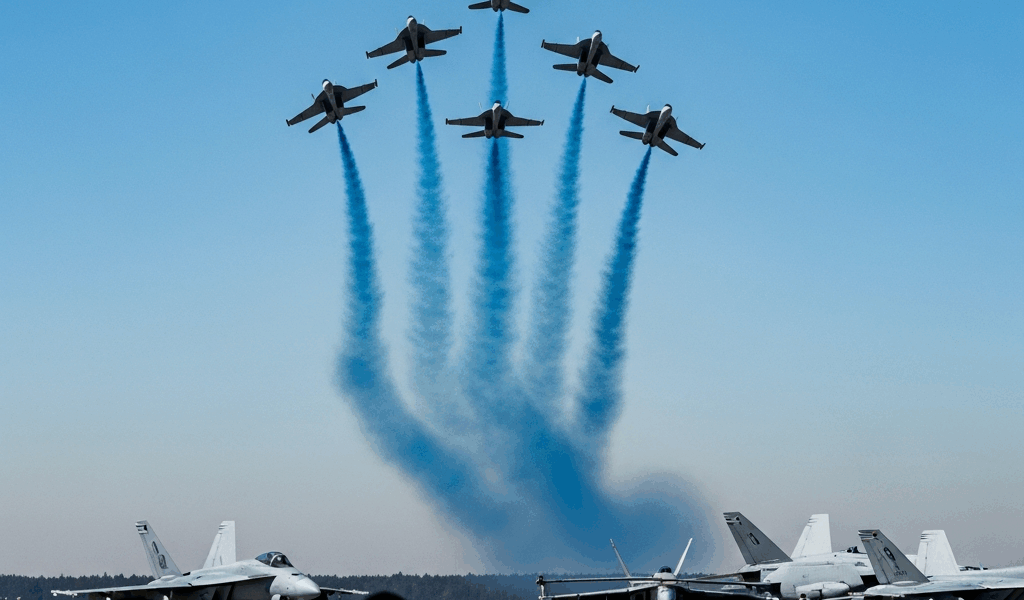
The U.S. Navy Blue Angels roared back into Lake Washington skies on Sunday, August 2, delivering the headlining act that spectators had come to see. Saturday’s performance never happened—dangerous winds forced organizers to pull the plug, pushing the six F/A-18 Super Hornets and their signature tight formations to the next day to close out the three-day festival running July 31 through August 2.
Wind speeds at Seattle-Tacoma International Airport had climbed to 17–23 mph Saturday afternoon, with gusts slamming 28–31 mph. That was too much. Those conditions exceeded the Blue Angels’ published safety thresholds for the kind of low-level aerobatic maneuvers they perform over the lake.
The Safety Call — Emily Cantrell’s Explanation
Seafair President and CEO Emily Cantrell faced the cameras Saturday to explain the painful decision. Months of preparation. Gone—at least for one day. “Seafair’s air show team monitored winds throughout the day, and saw an increase in winds in the afternoon,” Cantrell said. “Five other air show acts were able to safely perform based on wind conditions earlier in the day. The forecast indicated that winds would increase or be sustained through the evening. Winds exceeded the safe threshold per the Blue Angels specifications.”
“We are confident that based on the current forecast, the team will perform on Sunday.”
It was a call rooted in an unwavering priority: keeping pilots and spectators safe. Cantrell had hammered that message all week. For ticket holders—who’d forked over $55 for general admission or up to $1,000 for premium log boom seats—the news stung. But organizers honored all Saturday tickets for Sunday’s festival and gate entry. Emma Marquez, an Oregon resident traveling with family, had booked hotel rooms for the weekend. The gesture helped ease the sting.
Five Acts Flew; One Waited for Better Conditions
Saturday’s shortened schedule revealed how precision and caution rule air show operations. Five civilian and military demonstration teams launched during the morning and early afternoon, when winds cooperated. Only the Blue Angels—whose F/A-18 Super Hornets pull knife-edge rolls and high-G maneuvers just 350 feet above the water—couldn’t safely fly those afternoon conditions.
Sunday brought a different story. The forecast called for lighter, steadier breezes. Perfect for what the Blues had planned. The full program kicked off at 10:30 a.m., with the Blue Angels performing as scheduled.
A Special Visitor — The Freedom Plane
Sunday’s airshow also made history at Seafair for the first time: a flyby of the National Archives Freedom Plane. A Boeing 737 painted in commemorative livery, it was touring eight cities to celebrate America’s 250th anniversary—carrying founding-era documents along the way. The aircraft passed over Lake Washington just before the Blues took the stage. Through August 16, visitors can see the Freedom Plane on display at the Museum of History and Industry, adding a civic gravitas to the aerial show.
Next Up for Air Show Fans
The 2026 Seafair marks the Blue Angels’ 80th year as a demonstration team—and the festival’s 77th. Weather cancellations remain rare. Yet they happen. Sunday’s performance kept Seattle’s tradition alive, a legacy stretching back to 1950 when Seafair first launched, just four years after the Blue Angels themselves took flight in 1946.
West Coast fans tracking the Blue Angels should keep an eye on the team’s official schedule for upcoming appearances. The Museum of Flight, which welcomed Jet Blast Bash spectators on Sunday, continues showcasing its air show exhibits—a destination for any aviation enthusiast planning their next adventure.


Stay in the loop
Get the latest airshow spectacle updates delivered to your inbox.