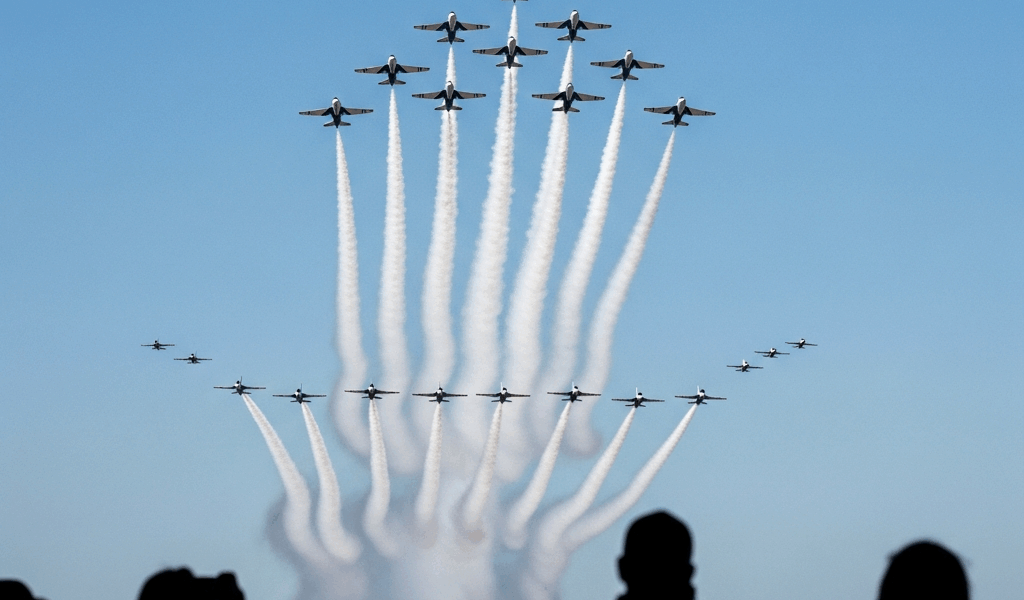
The Canadian Forces Snowbirds landed at the Canadian Warplane Heritage Museum in Hamilton, Ontario on June 17. It was one of their final Canadian stops before an extended grounding that will silence the team’s iconic CT-114 Tutors until the early 2030s.
The formation arrived after 55 years of continuous air demonstration service. They conducted a formation flyover of Niagara Falls alongside the museum’s B-25J Mitchell bomber, which displays the markings of RAF No. 98 Squadron—a deliberate nod to 431 Bomber Squadron, the Royal Canadian Air Force’s Second World War heavy bomber unit. The modern 431 Air Demonstration Squadron traces its lineage directly to that heritage.
“It was a chance to pay tribute to the proud history of 431 Bomber Squadron, a legacy we’re proud to have inherited,” Snowbirds officials stated via 610 CKTB.
The museum’s Avro Lancaster—one of only two airworthy examples anywhere—stayed grounded that day. But museum leadership seized the moment, temporarily marking the aircraft’s port side in the livery of a wartime 431 Squadron Lancaster. Dave Rohrer, president and CEO of the Canadian Warplane Heritage Museum, explained what the visit meant. “It means everything. They’ve been such great ambassadors to Canada for so many years. For us to have them in the Hammer and take the time to come here, it means a great deal because our whole mission as the Canadian Warplane Heritage is to remember our military aviation heritage.”
The Final Countdown
On May 19, 2026, the Department of National Defence made it official: the Snowbirds would retire their aging CT-114 Tutors at the conclusion of the 2026 show season on October 11. An era was ending. The jets, which first flew in 1960 and have been repeatedly extended beyond their original service life, will be replaced by the Pilatus PC-21 turboprop—designated the CT-157 Siskin II in Canadian service. The new platform is expected to achieve operational capability in the early 2030s, creating a significant gap in Canada’s air demonstration program.
The Prime Minister acknowledged the emotional weight of the transition, stressing that the Tutor aircraft “should have been replaced a long time ago.” The RCAF extended the Tutor’s lifespan in 2020, but Commander Jamie Speiser-Blanchet confirmed that further extension was impossible. The squadron, headquartered at 15 Wing Moose Jaw, Saskatchewan, will maintain that home station under the new aircraft.
Retired Colonel Dan Dempsey, speaking for the Snowbirds Alumni Association, sounded a cautionary note. “While the Association acknowledges the government’s commitment to equip the Snowbirds with the new aircraft platform in the future, concerns remain regarding the loss of operational expertise and the prolonged interruption of one of Canada’s most important military outreach programs during the transition.”
What’s Ahead
The Snowbirds’ farewell tour continues through October, with confirmed performances at Columbus Airshow (June 19–21) and other Eastern Canadian venues. The October 11 finale is scheduled for California—though RCAF Commander Speiser-Blanchet indicated the final show location could shift to allow the Tutors to retire on home soil.
Over 55 years, the team has performed more than 2,700 displays for approximately 140 million spectators. Ten Canadian Armed Forces members have been lost in service with the Snowbirds; each performance is dedicated to their memory.


Stay in the loop
Get the latest airshow spectacle updates delivered to your inbox.